Why are we ticklish? What tickling reveals about the brain
Sole of the foot, sides, neck: why some areas are ticklish, why you can't tickle yourself and why we laugh.
The RNP training space, free for life
Get access to RNP training, no strings attached.
Tickle a rat on the belly: it lets out ultrasonic calls, comes back looking for the hand and starts bouncing on the spot. In 2016, two neuroscientists recorded what its cortex does in the meantime, and what they saw sheds light on a very old question.
No time? Take this away.
We are ticklish because certain areas of skin, highly reactive to light touch, receive an external contact that the brain cannot predict the way it predicts its own movements. The word covers two phenomena, the light tickle that makes you jump and the firm tickle that makes you laugh. Why the foot, the sides or the neck react more than the fingertips, and why we laugh, remains debated: protecting vulnerable areas and social play are hypotheses. And a tickle calmed by pressure always comes back.
Hello to you, the movement professional,
Ishiyama and Brecht tickled rats while recording the neurons of the trunk region in their somatosensory cortex, the area of the brain that receives touch (Ishiyama and Brecht, 2016). Most of these neurons went into overdrive, and the rats' spontaneous bounces, which the authors call Freudensprünge, joy jumps. Placed in anxiety-inducing conditions, and this is the line that made us reread the paper, they fell silent, and the activity of the area dropped with them. A microstimulation of its deep layers was enough, for its part, to trigger the vocalizations with no hand on the belly at all.
Panksepp and Burgdorf had paved the way: their tickled young rats emit calls around 50 kHz, learn a task in order to get tickled, and four generations of selection were enough to obtain lines that vocalize a lot or a little (Panksepp and Burgdorf, 2000). As a working hypothesis, they see in it a distant relative of children's laughter (Panksepp and Burgdorf, 2003).
You will object that a rat is still a rat, and you will be right: nothing carries over as is to the person you work with. We keep two ideas from it, to be confronted with human data: tickling plays out in the brain as much as on the skin, and context can switch it off. That is also why it "disappears" so easily in session, as we showed with the tickle that fades after pressure under the foot.
Which tickle are we talking about, exactly?
Knismesis and gargalesis: the two kinds of tickle
Hall and Allin coined the words in 1897, taken up by Selden (2004). Knismesis is the light tickle of the feather or the insect wandering over the forearm: it makes you jump, makes you want to scratch, and you would gladly do without it. Gargalesis requires fingers that press and insist in the ribs, and it is the one that makes you laugh. Selden suggests, in the conditional, that the second might combine touch and itch and travel through other receptors and other pathways than the first.
When a person tells you "my feet are very ticklish," ask which of the two. Pulling the foot away at the first brush and bursting out laughing when someone insists tell two different things about their system.
Ticklish areas: sole of the foot, sides, neck and armpits
The sole of the foot is hairless skin, like the palm, equipped with several families of low-threshold cutaneous mechanoreceptors (Purves et al., 2004, ch. 8). Among the mechanoreceptors of the sole of the foot, the rapidly adapting ones dominate: seven out of ten fibers recorded in Kennedy and Inglis (2002). They fire when something moves on the skin and fall silent when it stops: a light touch that keeps changing direction speaks to them directly.
The sides, the neck and the armpits carry hairy skin, where nerve endings wrap around the hairs and signal their slightest movement (Enoka, 2008, ch. 7). Picture a feather on the nape of the neck, laying the hairs flat as it passes.
Except that receptor density doesn't explain everything. The fingertips, where tactile discrimination reaches its finest resolution (Purves et al., 2004, ch. 8), rarely make anyone laugh. Why some areas are more ticklish than others is unknown (Selden, 2004), and no theory yet explains this geography in a satisfying way (Kilteni, 2025).
That leaves the vulnerable-areas hypothesis. The neck, the sides and the belly protect vital structures, and Selden proposes that ticklish areas are the ones we let be "invaded" in a game of dominance and submission. It fits the neck and the ribs, fits the sole of the foot poorly, and to our knowledge nobody has tested it directly.
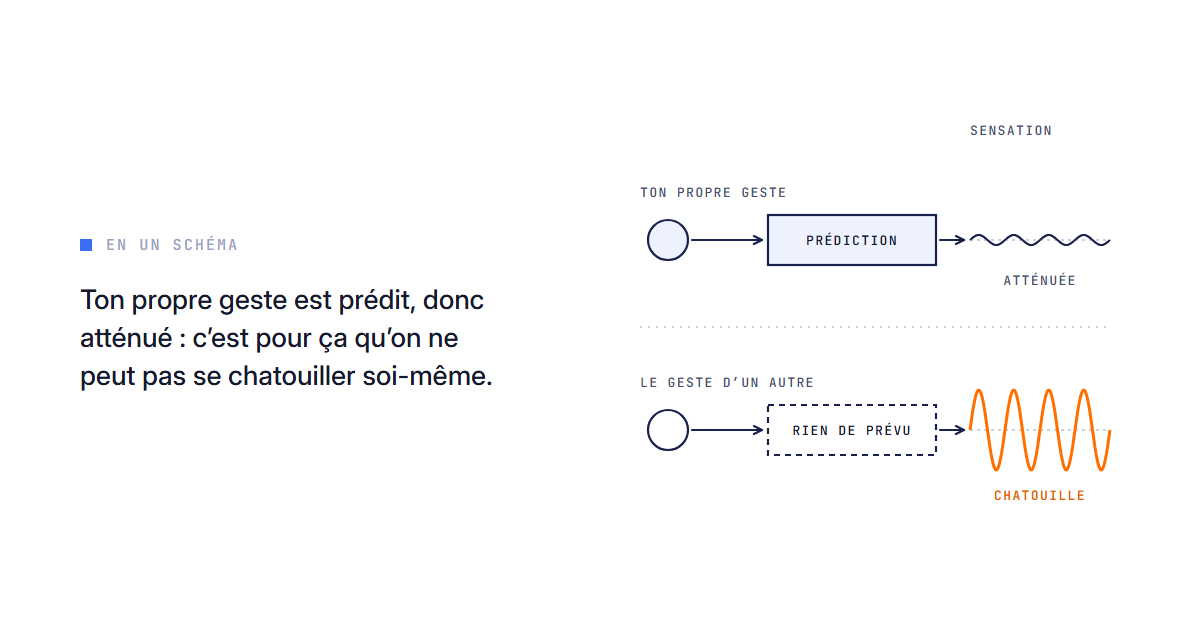
Why you can't tickle yourself
The finding has been published since 1971 (Weiskrantz et al., 1971). The best-supported explanation runs through prediction: when you move, your brain keeps an efference copy of the command, deduces the expected sensation from it and attenuates it, with a probable role for the cerebellum (Blakemore et al., 1998). The more the gap grows between the predicted sensation and the one that arrives, the more ticklish the contact becomes again (Blakemore et al., 2000). We devoted a whole text to this impossibility of tickling yourself, and the notion of reafference sets out the framework.
Knowing that a tickle is coming doesn't protect you, though, when it comes from someone else. In 31 volunteers, the anticipation of a tickle on the foot activated the anterior insula, and the stronger this activity was, the more the person laughed afterward (Wattendorf et al., 2019). Predicting your own movement and waiting for someone else's movement are two different operations for the brain.
That leaves the question everyone ends up asking: why laugh at something you are trying to escape?
Why tickling makes us laugh: hypotheses, none settled
One of the oldest goes back to Darwin and Hecker: tickling and humor would share the same mainspring. Fridlund and Loftis (1990) surveyed 100 students: those who described themselves as ticklish also reported giggling, laughing and smiling more easily. The authors themselves speak of preliminary support, drawn from a questionnaire.
Another lead sets the relationship, which would require another person, against the reflex, which would be satisfied with an unpredictable contact. Harris and Christenfeld (1999) tickled 35 people twice, by the experimenter and then by a "machine" they believed in: they smiled, laughed and squirmed just as much, which leans toward the reflex.
Selden (2004) defends almost the opposite: tickle laughter would be mostly social, born in the bond between mother and child and then in play, where laughter and withdrawal signal submission. In the rat, a neuron's response to tickling predicted its response during play (Ishiyama and Brecht, 2016). The idea of training to protect your vulnerable areas also circulates, with no study testing it to our knowledge.
These leads partly contradict each other, and Kilteni (2025) admits that we still don't know whether we laugh because we like being tickled. We won't settle it in her place.
Ticklish or not: differences between individuals that are still poorly explained
You have certainly met, in session, the person who writhes at the first brush and the one who doesn't flinch. Nobody really knows why (Kilteni, 2025). In the rat, housing, selection (Panksepp and Burgdorf, 2000) and anxiety (Ishiyama and Brecht, 2016) all make the response vary. In humans, Wattendorf suggests that part of the gap plays out during the wait, before the contact, and it remains a correlation.
When light touch becomes unbearable in daily life, to the point of interfering with getting dressed, we leave the territory of tickling: that is the subject of our article on tactile hypersensitivity in adults, and that picture deserves a doctor's opinion.
Claim | Level of evidence |
|---|---|
Self-tickle attenuated by prediction | Established (Blakemore, 1998 and 2000) |
Anxiety switches off the response | Established in the rat (Ishiyama, 2016) |
Ticklish areas = vulnerable areas | Untested hypothesis (Selden, 2004) |
Link between tickling and humor | Self-reported correlation (Fridlund, 1990) |
Reflex or social laughter | Debated (Harris, 1999; Selden, 2004) |
A tickle erased by pressure always comes back
Thirty seconds of firm pressure under the sole and the person no longer reacts to light touch: the rapid receptors go quiet under pressure, the system habituates, the context has changed. Our pillar article dissects these mechanisms one by one. All of them fade, and the tickle comes back.
An immediate effect shows a passing state, it proves nothing lasting. Ishiyama's rat, silent as soon as it is placed in anxiety-inducing conditions, reminds us of this in its own way. In our professions, what matters is verified at the retest the next day or the following week, and it is built through programming.
What tickling still keeps to itself
We still don't know why the sole tickles more than the fingertips, where the differences between people come from, and what this laughter is for. The rats say context matters; in humans, that remains to be shown.
This reading is easy to put to the test. If context weighs as much as skin, the same person, brushed without warning in the same spot with the same brush, should react differently depending on whether they are relaxed and trusting or on their guard. If the response stayed identical from one context to the other, you would have to look for the essentials in the skin.
A tickle tells you how the brain reads a contact at a given moment; what has really changed, only the next day can tell.
👉 I want to intervene in the right place
Frequently asked questions
Why are our feet ticklish?
The sole carries a majority of rapidly adapting mechanoreceptors, very sensitive to a moving, unpredictable light touch. Why it tickles more than the fingertips remains poorly explained.
Why can't we tickle ourselves?
The brain predicts the sensation produced by its own movement and attenuates it (Blakemore et al., 1998).
What are the most ticklish areas?
Sole of the foot, sides, ribs, neck, armpits: these are the ones people name spontaneously. Why these, we still don't know.
Can you stop being ticklish?
Firm pressure or a repeated tickle calms the reaction for a while. No data show that it can be made to disappear for good.
By the LabO RNP team
LabO RNP is neither a medical nor a paramedical structure. Our approaches complement a care pathway, they never replace it.
References
Ishiyama S, Brecht M. Neural correlates of ticklishness in the rat somatosensory cortex. Science. 2016;354(6313):757-760. doi:10.1126/science.aah5114. PMID 27846607.
Panksepp J, Burgdorf J. 50-kHz chirping (laughter?) in response to conditioned and unconditioned tickle-induced reward in rats: effects of social housing and genetic variables. Behav Brain Res. 2000;115(1):25-38. doi:10.1016/s0166-4328(00)00238-2. PMID 10996405.
Panksepp J, Burgdorf J. "Laughing" rats and the evolutionary antecedents of human joy? Physiol Behav. 2003;79(3):533-547. doi:10.1016/s0031-9384(03)00159-8. PMID 12954448.
Hall GS, Allin A. The psychology of tickling, laughing, and the comic. Am J Psychol. 1897;9(1):1-42. doi:10.2307/1411471.
Selden ST. Tickle. J Am Acad Dermatol. 2004;50(1):93-97. doi:10.1016/s0190-9622(03)02737-3. PMID 14699372.
Purves D, Augustine GJ, Fitzpatrick D, et al. Neuroscience, 3rd ed. Sunderland (MA): Sinauer Associates; 2004. Chapter 8 (somatosensory system).
Kennedy PM, Inglis JT. Distribution and behaviour of glabrous cutaneous receptors in the human foot sole. J Physiol. 2002;538(3):995-1002. PMID 11826182.
Enoka RM. Neuromechanics of Human Movement, 4th ed. Champaign (IL): Human Kinetics; 2008. Chapter 7.
Kilteni K. The extraordinary enigma of ordinary tickle behavior: Why gargalesis still puzzles neuroscience. Sci Adv. 2025;11(21):eadt0350. doi:10.1126/sciadv.adt0350. PMID 40408489.
Weiskrantz L, Elliott J, Darlington C. Preliminary observations on tickling oneself. Nature. 1971;230(5296):598-599. PMID 4928671.
Blakemore SJ, Wolpert DM, Frith CD. Central cancellation of self-produced tickle sensation. Nat Neurosci. 1998;1(7):635-640. doi:10.1038/2870. PMID 10196573.
Blakemore SJ, Wolpert D, Frith C. Why can't you tickle yourself? NeuroReport. 2000;11(11):R11-R16. doi:10.1097/00001756-200008030-00002. PMID 10943682.
Wattendorf E, Westermann B, Fiedler K, et al. Laughter is in the air: involvement of key nodes of the emotional motor system in the anticipation of tickling. Soc Cogn Affect Neurosci. 2019;14(8):837-847. doi:10.1093/scan/nsz056. PMID 31393979.
Fridlund AJ, Loftis JM. Relations between tickling and humorous laughter: preliminary support for the Darwin-Hecker hypothesis. Biol Psychol. 1990;30(2):141-150. doi:10.1016/0301-0511(90)90023-p. PMID 2285764.
Harris CR, Christenfeld N. Can a machine tickle? Psychon Bull Rev. 1999;6(3):504-510. doi:10.3758/bf03210841. PMID 12198790.
Read next
Sensory Sensors - Proprioception
Learning pyramid and posturology: posture as a load-bearing level
Learning pyramid and posturology: posture at levels 3 and 4, its sensors, its link with attention and gaze, and the level of evidence.
Read the article Sensory Sensors - ProprioceptionThe sensory systems of the learning pyramid: why the body's senses come first
Sensory systems of the learning pyramid: tactile, vestibular and proprioceptive, habituation, interoception, and how to read them in the athlete.
Read the article Sensory Sensors - ProprioceptionLight Touch, Rhythmic Pressure, Deep Pressure: Why the Same Tactile Stimulation Doesn't Work for Everyone
Light touch, rhythmic or deep pressure, vibration: each tactile receptor has its preferred stimulus. Why the same gesture divides responses.
Read the articleReady to read the loop before the movement?
The RNP system is meant to be read, targeted and tested from your next assessment. Start with the member space, for free.