Habituation: why the brain stops responding, and what it takes for it to last
Habituation in neuroscience: definition, Rankin criteria, Kandel's Aplysia, sensitization, short and long term. Why the effect doesn't last.
The RNP training space, free for life
Get access to RNP training, no strings attached.
The refrigerator has been humming for an hour and nobody hears it anymore. The compressor cuts out, and it is the silence that makes you look up. Between the two plays out the simplest form of learning we know, and one of the most fragile.
Hello to you, the movement professional,
Habituation is the decline of a response to a stimulus that repeats without consequence, with neither the sensors nor the muscles being at fault. Neuroscience ranks it among the most elementary forms of learning, and it bears directly on our professions: it fades by itself when the stimulus stops. What makes it last best is spaced repetitions, over several days in the clearest experiments, and in animals that durability goes through new proteins and modified synapses.
In our article on the tickle that disappears after thirty seconds of pressure under the foot, habituation took up one paragraph, even though it explains a good part of what you see decline in session. The objection comes quickly: if a response diminishes over repetitions, the system has indeed learned something. That's true. What remains is to know what, and for how long.
Go back to the kitchen, and a researcher would see two things there. The silence you notice shows that habituation is tied to the repeated stimulus: the hum has gone out for you, but the slightest change still alerts you. Then the motor restarts, and you hear it for a few seconds. Because the noise had gone quiet, or because the silence woke you up again? A protocol has existed for sixty years to settle it.
Habituation: the neuroscience definition, from Thompson and Spencer to Rankin
In 1966, Thompson and Spencer published the behavioral characteristics that signal habituation. Forty years later, fourteen researchers working on very different species revised the list (Rankin et al., 2009). Their definition: "a behavioral response decrement that results from repeated stimulation", excluding sensory adaptation and motor fatigue. They add one criterion, long-term habituation.
Characteristic (Rankin et al., 2009) | What is observed |
|---|---|
Decrement | The response declines with repetition, down to a floor |
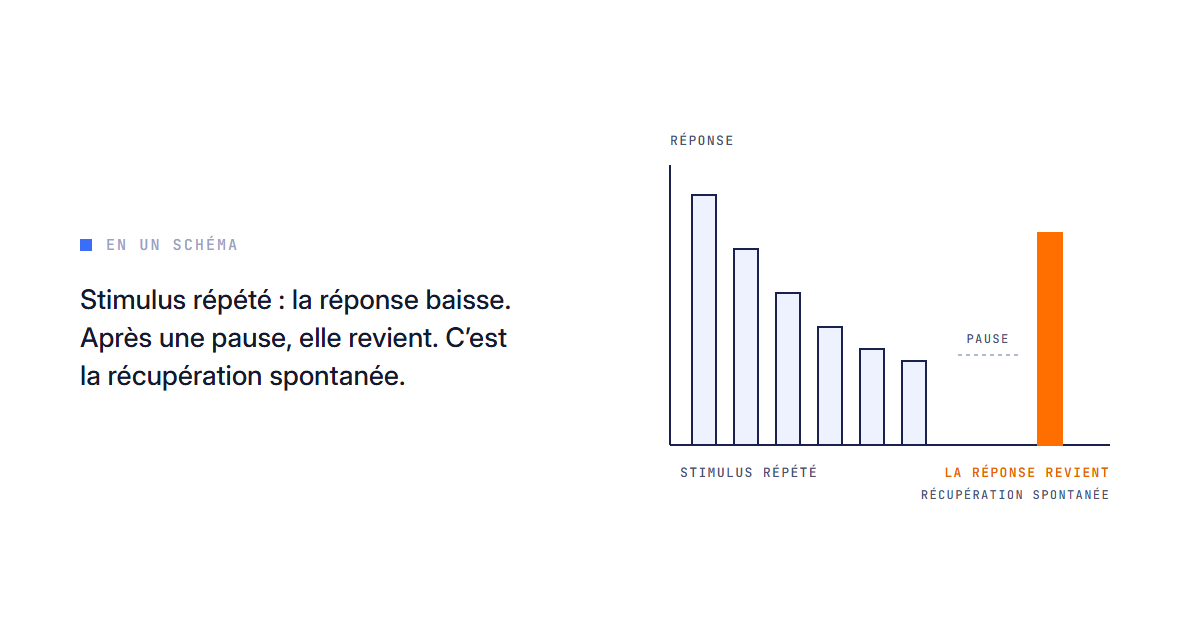
Spontaneous recovery | Stimulus removed, the response returns, partly or fully |
Potentiation | After several cycles, the decline becomes faster or more pronounced |
Frequency | Closely spaced stimulus: faster decline and faster return (floor reached) |
Intensity | Weak stimulus: faster decline; very intense: sometimes no clear decline |
Specificity | The decline stays specific to the repeated stimulus |
Dishabituation | Another stimulus brings the original response back up |
Long term | Some protocols leave a trace lasting hours, even weeks |
Reread the frequency line: tightly packed repetitions make the response drop fast, and let it return fast. The potentiation line, for its part, cools anyone who compares a third session to the first, us included: what drops faster the third time may be nothing more than a habituation settling back in.
Habituation, sensory adaptation or fatigue: three declines that look alike
A response that diminishes can come from a sensor that adapts, like the fast-adapting receptors of the skin under constant pressure, from a muscle that tires, or from a central nervous system that has learned to ignore what repeats.
Rankin and colleagues give three ways to settle it, starting with dishabituation: if a different stimulus brings the original response back up, the sensor and the muscle were still working. Specificity helps too, since an adaptation or a fatigue should affect all stimuli of the same modality. Recovery remains, which depends on the stimulation frequency only in habituation.
A response that declines does not, on its own, tell you where it declined.
Where does this decline sit in the nervous system?
Kandel and Aplysia: the synaptic depression of short-term habituation
Eric Kandel chose Aplysia, a marine mollusk (yes, a sea slug), for its giant neurons, located in the same place from one animal to the next. His project, retraced in his Nobel lecture: look for what changes in identified nerve cells when an animal learns (Kandel, 2001). Touching the siphon triggers withdrawal of the siphon and the gill, a defensive reflex that clearly habituates within ten trials (Carew et al., 1972).
In 1970, the team simultaneously recorded a sensory neuron and a motor neuron of this reflex, on an isolated ganglion connected to a piece of skin. Under repeated stimulation, transmission between them collapses; a strong stimulus on another pathway brings it back up (Castellucci et al., 1970). Four years later, a quantal analysis pinpointed the phenomenon: the sensory neuron releases fewer packets of neurotransmitter with each impulse, and the motor neuron's sensitivity does not budge (Castellucci and Kandel, 1974). The mechanism is presynaptic: less glutamate released (Purves et al., 2004, ch. 24).
All of this holds for a mollusk synapse. In humans, no demonstration reaches this level of detail: that a repeatedly engaged pathway ends up transmitting less remains a reasonable extrapolation, and we present it as such.
Sensitization: the opposite phenomenon to habituation
A shock to the tail of Aplysia amplifies the reflex instead: interneurons release serotonin onto the sensory terminals, which then release more glutamate. One shock lasts at least an hour, repeated shocks days or weeks (Purves et al., 2004, ch. 24). Groves and Thompson (1970) drew from this a dual-process theory, one process that makes the response decline, the other that makes it rise. In session, and this is a field reading, a stimulus experienced as threatening does not necessarily habituate, it may even sensitize.
So what makes a habituation last?
Short-term and long-term habituation: spacing, proteins, synapses
Carew, Pinsker and Kandel (1972) put the question to the whole animal: five daily sessions produce a habituation that accumulates from day to day and holds for at least three weeks, and spacing makes it clearly more durable than massed training. Bailey and Chen (1983) then examined the fine structure of the sensory terminals: in long-term habituation, their active zones are fewer, smaller and poorer in vesicles, and the reverse is seen after sensitization.
Ezzeddine and Glanzman (2003) add an awkward piece: a habituation that persists one to six hours after spaced blocks is blocked by an inhibitor of protein synthesis, and it requires glutamate receptors on the postsynaptic side. The presynaptic depression of the short term therefore doesn't explain everything, and Rankin et al. (2009) judge it likely that the long term rests on qualitatively different mechanisms. Textbooks draw a rule from this: the short term modifies existing proteins, the long term requires new proteins and synapses that are built or disappear (Purves et al., 2004, ch. 24).
In Aplysia, what lasts was built in several goes, with pauses, and left a trace in the structure.
Claim | Level of evidence |
|---|---|
Short term: presynaptic depression | Established in Aplysia |
Long term: spacing, protein synthesis, structural change | Established in Aplysia |
Same cellular mechanisms in humans | Plausible extrapolation, not demonstrated |
Transposition to the session | Field reading |
Session effect or lasting learning: retention settles it
You stimulate an area, you repeat, and something drops: a tension that lets go, a withdrawal that no longer fires. Before seeing progress in it, think back to spontaneous recovery, because a decline obtained in twenty minutes may be a habituation, back by the next session.
Motor learning knows the same distinction: in their review, Kantak and Winstein (2012) conclude that delayed retention tells you more about learning than performance at the end of practice. That is the thread of our letters on a hundred perfect repetitions that don't hold, on the finest session that taught nobody anything and on the fault corrected for months that always comes back.
An immediate effect proves nothing. In our professions, what counts lies in the retest after some delay, and is built through programming, with intervals. In our grid, switching an input back on is often visible within the session; making it last is checked at a distance, which is where the duration of a stimulation effect is measured. The parallel with Aplysia's spaced training is tempting, and neuroplasticity makes it plausible, without these studies demonstrating it in humans.
A prediction to put to the test in your sessions: a response that declines clearly over the repetitions will have largely come back by the next session, and will decline faster again. If it stays low a week later, without a reminder and facing a standard stimulus, short-term habituation no longer explains anything, and you need to look for learning of a different nature.
What Aplysia doesn't yet tell us about our sessions
We don't know the share of adaptation, habituation and sensitization when a person's response changes in session. We also don't know which intervals make a decline in response durable in humans, Carew's five days applying to a mollusk. And installing a new response, which is often what we seek in session, belongs to another kind of learning, with its own rules.
A response that declines in session may rise again before the next one. One that stays low at the retest the following week has been learned.
👉 I want to step in at the right place
Habituation in four questions
What is the definition of habituation in neuroscience?
The decline of a behavioral response caused by repetition of a stimulus, excluding sensor adaptation and muscle fatigue (Rankin et al., 2009).
What is the difference between habituation and sensitization?
Habituation makes a response to a repeated stimulus without consequence decline, sensitization amplifies it after a strong stimulus. In Aplysia, one reduces neurotransmitter release, the other increases it.
What did Eric Kandel show with Aplysia?
That short-term habituation can be read at one precise synapse, where the sensory neuron releases less neurotransmitter with each impulse, and that spacing makes it more durable.
What if we want a habituation to hold?
In Aplysia, sessions spaced over several days held for at least three weeks. In humans, nothing is established, and only a retest after some delay will tell.
By the LabO RNP team
LabO RNP is neither a medical nor a paramedical organization. Our approaches add to a care pathway, they never replace it.
References
Thompson RF, Spencer WA. Habituation: a model phenomenon for the study of neuronal substrates of behavior. Psychol Rev. 1966;73(1):16-43. doi:10.1037/h0022681. PMID 5324565.
Rankin CH, Abrams T, Barry RJ, et al. Habituation revisited: an updated and revised description of the behavioral characteristics of habituation. Neurobiol Learn Mem. 2009;92(2):135-138. doi:10.1016/j.nlm.2008.09.012. PMID 18854219.
Kandel ER. The molecular biology of memory storage: a dialogue between genes and synapses. Science. 2001;294(5544):1030-1038. doi:10.1126/science.1067020. PMID 11691980.
Carew TJ, Pinsker HM, Kandel ER. Long-term habituation of a defensive withdrawal reflex in Aplysia. Science. 1972;175(4020):451-454. doi:10.1126/science.175.4020.451. PMID 17731371.
Castellucci V, Pinsker H, Kupfermann I, Kandel ER. Neuronal mechanisms of habituation and dishabituation of the gill-withdrawal reflex in Aplysia. Science. 1970;167(3926):1745-1748. doi:10.1126/science.167.3926.1745. PMID 5416543.
Castellucci V, Kandel ER. A quantal analysis of the synaptic depression underlying habituation of the gill-withdrawal reflex in Aplysia. Proc Natl Acad Sci USA. 1974;71(12):5004-5008. doi:10.1073/pnas.71.12.5004. PMID 4373738.
Purves D, Augustine GJ, Fitzpatrick D, et al. Neuroscience, 3rd ed. Sunderland (MA): Sinauer Associates; 2004. Chapter 24 (plasticity of synapses and mature circuits).
Groves PM, Thompson RF. Habituation: a dual-process theory. Psychol Rev. 1970;77(5):419-450. doi:10.1037/h0029810. PMID 4319167.
Bailey CH, Chen M. Morphological basis of long-term habituation and sensitization in Aplysia. Science. 1983;220(4592):91-93. doi:10.1126/science.6828885. PMID 6828885.
Ezzeddine Y, Glanzman DL. Prolonged habituation of the gill-withdrawal reflex in Aplysia depends on protein synthesis, protein phosphatase activity, and postsynaptic glutamate receptors. J Neurosci. 2003;23(29):9585-9594. doi:10.1523/JNEUROSCI.23-29-09585.2003. PMID 14573538.
Kantak SS, Winstein CJ. Learning-performance distinction and memory processes for motor skills: a focused review and perspective. Behav Brain Res. 2012;228(1):219-231. doi:10.1016/j.bbr.2011.11.028. PMID 22142953.
Read next
Definitions of the Sensorimotor Loop: Fundamental Principles of Postural Control
Learning Pyramid and Functional Neurology: The Neuromechanics the Diagram Simplifies
Learning pyramid and functional neurology: brainstem, cerebellum, proactive and retroactive reflex stability, the neuromechanics behind the diagram.
Read the article Definitions of the Sensorimotor Loop: Fundamental Principles of Postural ControlDale's Pyramid: where the percentages in the learning pyramid come from
Dale's Pyramid: Edgar Dale never published the percentages (10% read, 90% taught). Their real origin, the rebuttals and what research says.
Read the article Definitions of the Sensorimotor Loop: Fundamental Principles of Postural ControlThe Pyramid of Learning by Williams and Shellenberger: the 5 levels, their origin and their limits
Pyramid of Learning by Williams and Shellenberger: the 5 levels, the 22 skills, its origin (Taylor and Trott, 1991) and its limits.
Read the articleReady to read the loop before the movement?
The RNP system is meant to be read, targeted and tested from your next assessment. Start with the member space, for free.