Why you're no longer ticklish after 30 seconds of pressure (and why it proves nothing)
Thirty seconds of pressure under the foot and the tickle disappears. Receptor adaptation, habituation, prediction: why the effect doesn't last.
The RNP training space, free for life
Get access to RNP training, no strings attached.
A feather under the foot, the person jumps. Thirty seconds of firm pressure on the sole, you try again, nothing. The scene circulates on social media as proof of reprogramming. It mostly shows mechanisms well known to neuroscience, and none of them lasts.
No time? Remember this.
Thirty seconds of pressure under the foot calm the tickle for reasons that have long been known: the light-touch sensors go quiet under constant pressure, and the nervous system gets used to a repeated stimulus. These effects fade on their own within a few minutes, and the next day the person is as ticklish as before. A "before and after" wrapped up in five minutes, as it circulates on social media, therefore proves nothing at all: it films a passing state, and we believed in it too before we truly understood tactile receptors. Only a retest at a distance, the next day or the following week, tells you whether something has really changed.
Hello to you, the movement professional,
In recent weeks, the same video keeps coming back in our news feeds, with a few variations. A person lying down, barefoot. Someone brushes the sole of their foot, they squirm, laugh, pull the leg away at once. The practitioner then places their thumbs under the arch and presses firmly for about thirty seconds. Another brush: the person no longer moves. The edit stops on an astonished face, and the caption shouts nervous system reprogramming.
We watched the scene several times, with the curiosity of people whose work also goes through the foot. The phenomenon is real, and you can reproduce it in a session tomorrow. What stopped us was less the effect than the caption. The most serious objection is easy to put into words: "I saw it, the person no longer reacts, so something changed." It is legitimate, and something did change. What remains is to know what, and for how long.
What exactly happens under those thumbs during thirty seconds?
Two kinds of tickle and a very talkative sole
Researchers have distinguished two phenomena since the late 19th century (Hall and Allin, 1897; Selden, 2004). Knismesis is the light tickle, that of the feather or of the insect wandering over the skin, which makes you jump and makes you want to scratch. Gargalesis is the pressed, repeated tickle that triggers laughter. The video mainly plays the first: a light, moving, unpredictable brush.
The sole of the foot lends itself to this particularly well. It is hairless skin, like the palm, equipped with four types of low-threshold mechanoreceptors: the Meissner and Pacinian corpuscles, the Merkel discs and the Ruffini endings (Purves et al., 2004, ch. 8; Enoka, 2008, ch. 7). These sensors continuously feed postural control, telling it where the support bears and when it slips. When Kennedy and Inglis (2002) recorded the sensory fibers of the sole one by one, 104 receptors in 13 adults, seven out of ten belonged to the fast-adapting families.
The sole is also the entry point for two archaic reflexes that pediatricians examine in infants. The first is the plantar grasp reflex: pressure under the base of the toes makes them curl, as if to grip the ground. Present from birth, it is triggered reliably during the first six months, and its weakness or absence at that age alerts the pediatrician (Futagi and Suzuki, 2010). The second is the plantar cutaneous reflex, that of Babinski. The outer edge of the sole is stroked, from heel to toes. In the infant, the big toe lifts; the response then shifts toward toe flexion over the first two years, as the corticospinal tract, which connects the motor cortex to the spinal cord, matures. Joseph Babinski described big toe extension in adults as a neurological sign in 1896, and he had already linked it to the newborn's response (van Gijn, 1996). In an adult, such a response is a matter for a physician, never for a session.
This detour says one simple thing: the skin of the sole is wired to trigger automatic motor responses, up to withdrawal of the whole leg (Enoka, 2008, ch. 7). A ticklish foot therefore combines sensors that are very sensitive to change and response circuits ready to fire.
Why would thirty seconds of pressure silence all that?
First mechanism: sensors that go quiet under constant pressure
Mechanoreceptors do not all encode the same thing. Meissner and Pacini adapt quickly: they fire at the beginning and at the end of a contact, then go quiet if the stimulus stays still. They signal what moves on the skin. Merkel and Ruffini, for their part, keep firing as long as the pressure lasts, which informs the system about the shape of what is pressing and about skin stretch (Purves et al., 2004, ch. 8). Enoka (2008) describes the Meissner corpuscle as sensitive to sustained pressure, with a response that fades quickly.
Picture the scene from the sensors' side. The feather sliding under the arch is exactly the stimulus the fast receptors expect, light and full of micro-changes. The motionless thumbs crushing the arch for thirty seconds offer the opposite. The fast receptors in the area fire at first contact then go on standby, and what travels up to the spinal cord becomes a stable pressure signal, carried by the slow receptors. We changed the nature of the signal sent, without modifying anything in the person.
Just afterward, local sensitivity remains a little blunted, for as long as it takes the fibers to return to their resting state. This is sensory adaptation, a basic property of nearly all the body's sensors.
If the effect stopped at the skin, it would vanish in a few seconds. So why does the person stay calm longer?
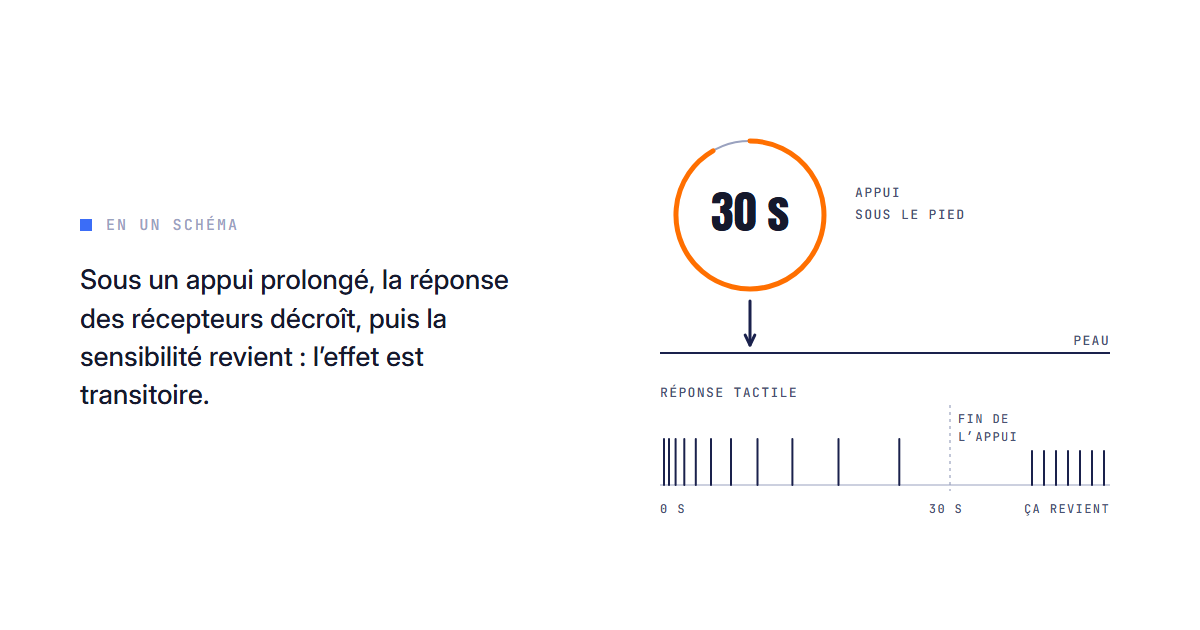
Second mechanism: habituation, or why you no longer feel your socks
The central nervous system adds its own layer. When a stimulus repeats without consequence, the response diminishes: this is habituation, the simplest form of learning we know (Thompson and Spencer, 1966). Eric Kandel and his team described its cellular mechanism in Aplysia, a marine mollusk. With repetition, transmission between sensory neuron and motor neuron weakens and the withdrawal reflex fades with it (Castellucci et al., 1970), because the sensory neuron releases less neurotransmitter with each impulse (Castellucci and Kandel, 1974; Purves et al., 2004, ch. 24).
You live this mechanism every morning. You put on your socks, you feel the fabric, the seam, the tight elastic, then after a few minutes you no longer think about it. Nobody sees a reprogramming of the foot in that.
Among the criteria that define habituation, researchers retain spontaneous recovery: when the stimulus stops, the response returns with time (Rankin et al., 2009). A new or surprising stimulus can even restore it at once, which is dishabituation, and it is precisely this test that distinguishes habituation from mere sensor adaptation. A habituation that never wore off would step outside its own definition.
Textbooks draw a simple rule from this for plasticity. Short-term effects rest on modifications of proteins already present in the synapse; long-term ones require repeated stimulation, protein synthesis and the growth of new connections (Purves et al., 2004, ch. 24). Thirty seconds belong to the first register.
Could part of the effect play out even before contact, in the person's head?
Third and fourth mechanisms: the gate and prediction
The gate control theory, proposed in 1965 by Ronald Melzack and Patrick Wall, explains a gesture everyone knows: rubbing an area you have just bumped calms the sensation. Activation of the large tactile fibers recruits, in the dorsal horn of the spinal cord, inhibitory interneurons that brake the transmission of other signals (Melzack and Wall, 1965; Purves et al., 2004, ch. 9). The model was established and debated for nociceptive signals. Applying it to tickling remains an extrapolation, which we flag as such: firm, prolonged pressure massively activates these large fibers and could filter for a time what arrives next.
The fourth mechanism is the best documented for tickling itself, and also the one that calls for the most caution. You cannot tickle yourself, an observation published as early as 1971 (Weiskrantz et al., 1971). In 1998, Blakemore, Wolpert and Frith showed with functional MRI that the somatosensory cortex activates less when the contact is produced by the person themselves, and that the cerebellum reacts differently depending on whether the gesture touches the skin or not. Their reading: a predictive model, fed by the efference copy of the gesture, announces the sensation and attenuates it. The title of their article says it plainly: "Central cancellation of self-produced tickle sensation". This sensory attenuation is solid for a contact you give yourself.
For an external contact, the data point in both directions. A functional MRI study of 31 volunteers even showed that anticipating a tickle on the foot activates the insula, and that this activity predicts the intensity of the laughter that follows (Wattendorf et al., 2019). Knowing it is coming therefore does not necessarily protect against the tickle. Think back to the video with this caution: at the second brush, the person has spent thirty seconds relaxed under hands that were not threatening them, the context has changed, and nothing guarantees that the second contact is read like the first. We cannot say more without measurement.
How do you apportion these four layers?
What we know, what we suppose
Mechanism | Where it acts | Expected duration | Level of evidence |
|---|---|---|---|
Adaptation of fast receptors | Skin | A few seconds | Established (Purves; Enoka) |
Habituation | Synapses of the spinal cord and brain | A few minutes, then spontaneous recovery | Established (Thompson and Spencer; Kandel; Rankin) |
Gate via large fibers | Dorsal horn of the spinal cord | For the duration of the pressure, slightly beyond | Established for nociceptive signals, extrapolated to tickling |
Attenuation by prediction | Cerebellum and somatosensory cortex | For the duration of the self-produced gesture | Established for self-tickling (Blakemore, 1998); uncertain for an expected external contact (Wattendorf, 2019) |
To our knowledge, no study has measured this precise protocol, thirty seconds of pressure then tickle, with a control group. The share of each mechanism therefore remains a reading, built on solid bricks.
Why the immediate before and after proves nothing
The video stacks up biases. The first brush arrives by surprise, the second is expected. The practitioner does not necessarily brush the same way both times, nor in the same place. The person has changed state in the meantime, more relaxed, sometimes eager to do well in front of the camera. And the measurement lands exactly when adaptation and habituation are at their maximum. Everything contributes to producing the effect, whatever theory you stick on it.
If you want to know whether something has really changed, the protocol comes down to four steps. Take a standard stimulus, always the same, a soft brush for example. Deliver it without warning and without the person looking, before then after. Repeat the measurement at ten minutes, then the next day. And compare with a control condition: thirty seconds of pressure on the other foot, or thirty seconds of doing nothing.
An effect that does not survive the retest at a distance remains a passing state.
Our prediction, which anyone can check: the tickle comes back within a few minutes, and it is fully there the next day. If it stayed absent at twenty-four hours with an unpredictable stimulus, our reading would be incomplete and we would have to look elsewhere.
What separates a transient effect from a change that holds
We say it all the more easily because we fell for it ourselves. In the 2010s, we too believed in this kind of before and after, convinced we had changed something in a few minutes. We stopped the day we truly understood tactile receptors: how they adapt, how the system habituates, and what that says about the duration of an effect. We do not claim to master everything, but enough to know that an instant effect teaches almost nothing. If these videos convince so many people, it is because the viewer lacks the basic physiology laid out above; with it, the effect loses its mystery, and you know in advance that it will come back. It has become our cause: judging a result at the retest, and building it through programming. In our professions, what counts is what holds at four weeks, not what impresses at four minutes.
We ourselves work on plantar inputs, with several families of stimulation: light brushes, rhythmic pressures, long deep pressures, textures. A stimulation under the foot often produces a visible immediate effect, a base of support that widens, a person who feels more settled on the ground. That is precisely why the immediate never serves as proof for us.
These stimulations are not equivalent from one person to another, and that can be explained. Each tactile receptor has its valence, the type of stimulus it responds to best; the first mechanism in this article gives a glimpse of it, the light brush speaks to the fast receptors, the held pressure to the slow receptors. Choosing a stimulation therefore amounts to choosing which receptors you address. When a technique gives a lot in one person and nothing in another, it is often because it was not addressing the receptors that this person needed. Without a prior reading, we attribute to the technique what belongs to the receptor.
Our grid has three steps: read where the body is in the dark, relight the input that is missing, then make it hold. The first two can produce an effect from the first session. The third is only verified at a distance, at the retest the following week, when the person comes back and the reading has changed without anything having been stimulated just before. This is the only moment when we speak of reprogramming: a map that has moved and stays in place.
How many of the before and afters in your news feed would pass this retest?
What nobody can yet promise you
We do not know today which mechanism weighs most in this scene, nor whether the proportion varies from one person to another. Reactions to tickling differ greatly between individuals, and this variability remains poorly explained. Nor do we know whether sessions repeated over weeks would durably modify the plantar sensitivity of someone very ticklish. The question deserves a real study, with a retest at a distance.
In the meantime, the next time you see a spectacular transformation in thirty seconds, ask the only question that counts: and the next day?
A sensation changes in thirty seconds. The map that produces it takes weeks, and a retest to prove it.
👉 I want to understand why, not just what
Frequently asked questions
Why are you no longer ticklish after a foot massage?
Firm, constant pressure silences the fast-adapting skin receptors, the ones that pick up light brushes. The nervous system gets used to the repeated stimulus, and the context of the second contact is no longer that of the first. All of these effects are temporary.
How long does the effect last?
Receptor adaptation dissipates in a few seconds, habituation in a few minutes. A surprising stimulus can restore the tickle immediately. The next day, sensitivity is back to its usual level.
Why can't you tickle yourself?
Because the brain predicts the sensation produced by its own hand and attenuates it before it arrives (Blakemore et al., 1998). The mechanism is detailed in our article on the efference copy.
How can you tell whether a technique really changes anything?
With a standard stimulus, a blinded measurement, a control condition and above all a retest at a distance: at ten minutes, the next day, the following week. An effect that disappears at the retest is a passing state.
By the LabO RNP team
LabO RNP is neither a medical nor a paramedical structure. Our approaches are added to a care pathway, they never replace it.
References
Purves D, Augustine GJ, Fitzpatrick D, et al. Neuroscience, 3rd ed. Sunderland (MA): Sinauer Associates; 2004. Chapters 8 (somatosensory system), 9 (nociception) and 24 (plasticity of synapses and mature circuits).
Enoka RM. Neuromechanics of Human Movement, 4th ed. Champaign (IL): Human Kinetics; 2008. Chapter 7.
Kennedy PM, Inglis JT. Distribution and behaviour of glabrous cutaneous receptors in the human foot sole. J Physiol. 2002;538(3):995-1002. PMID 11826182.
Futagi Y, Suzuki Y. Neural mechanism and clinical significance of the plantar grasp reflex in infants. Pediatr Neurol. 2010;43(2):81-86. PMID 20610116.
van Gijn J. The Babinski sign: the first hundred years. J Neurol. 1996;243(10):675-683. PMID 8923299.
Thompson RF, Spencer WA. Habituation: a model phenomenon for the study of neuronal substrates of behavior. Psychol Rev. 1966;73(1):16-43. PMID 5324565.
Castellucci V, Pinsker H, Kupfermann I, Kandel ER. Neuronal mechanisms of habituation and dishabituation of the gill-withdrawal reflex in Aplysia. Science. 1970;167(3926):1745-1748. PMID 5416543.
Castellucci V, Kandel ER. A quantal analysis of the synaptic depression underlying habituation of the gill-withdrawal reflex in Aplysia. Proc Natl Acad Sci USA. 1974;71(12):5004-5008. doi:10.1073/pnas.71.12.5004. PMID 4373738.
Rankin CH, Abrams T, Barry RJ, et al. Habituation revisited: an updated and revised description of the behavioral characteristics of habituation. Neurobiol Learn Mem. 2009;92(2):135-138. doi:10.1016/j.nlm.2008.09.012. PMID 18854219.
Melzack R, Wall PD. Pain mechanisms: a new theory. Science. 1965;150(3699):971-979. PMID 5320816.
Weiskrantz L, Elliott J, Darlington C. Preliminary observations on tickling oneself. Nature. 1971;230(5296):598-599. PMID 4928671.
Blakemore SJ, Wolpert DM, Frith CD. Central cancellation of self-produced tickle sensation. Nat Neurosci. 1998;1(7):635-640. doi:10.1038/2870. PMID 10196573.
Wattendorf E, Westermann B, Fiedler K, et al. Laughter is in the air: involvement of key nodes of the emotional motor system in the anticipation of tickling. Soc Cogn Affect Neurosci. 2019;14(8):837-847. PMID 31393979.
Hall GS, Allin A. The psychology of tickling, laughing, and the comic. Am J Psychol. 1897;9(1):1-42. doi:10.2307/1411471.
Selden ST. Tickle. J Am Acad Dermatol. 2004;50(1):93-97. doi:10.1016/s0190-9622(03)02737-3. PMID 14699372.
Read next
Sensory Sensors - Proprioception
Learning pyramid and posturology: posture as a load-bearing level
Learning pyramid and posturology: posture at levels 3 and 4, its sensors, its link with attention and gaze, and the level of evidence.
Read the article Sensory Sensors - ProprioceptionThe sensory systems of the learning pyramid: why the body's senses come first
Sensory systems of the learning pyramid: tactile, vestibular and proprioceptive, habituation, interoception, and how to read them in the athlete.
Read the article Sensory Sensors - ProprioceptionLight Touch, Rhythmic Pressure, Deep Pressure: Why the Same Tactile Stimulation Doesn't Work for Everyone
Light touch, rhythmic or deep pressure, vibration: each tactile receptor has its preferred stimulus. Why the same gesture divides responses.
Read the articleReady to read the loop before the movement?
The RNP system is meant to be read, targeted and tested from your next assessment. Start with the member space, for free.