Gate control theory (Melzack and Wall): why rubbing soothes, and what it is made to say
Melzack and Wall, 1965: touch dampens nociceptive signals in the spinal cord. What held up, what was corrected, and what it is wrongly made to say.
The RNP training space, free for life
Get access to RNP training, no strings attached.
A bumped elbow, a hand that rubs without a thought. Melzack and Wall drew a theory from it in 1965: its diagram has since been corrected, its principle has held, and it is made to carry far more than it demonstrates.
Hello to you, the movement professional,
You go through the door a bit fast and the point of your elbow hits the doorframe. A hot jolt shoots down to your fingers, which tingle. Your hand is already on it, flat, rubbing in small circles before you have decided anything. The sensation fades. You let go, it comes back a little, so you rub again.
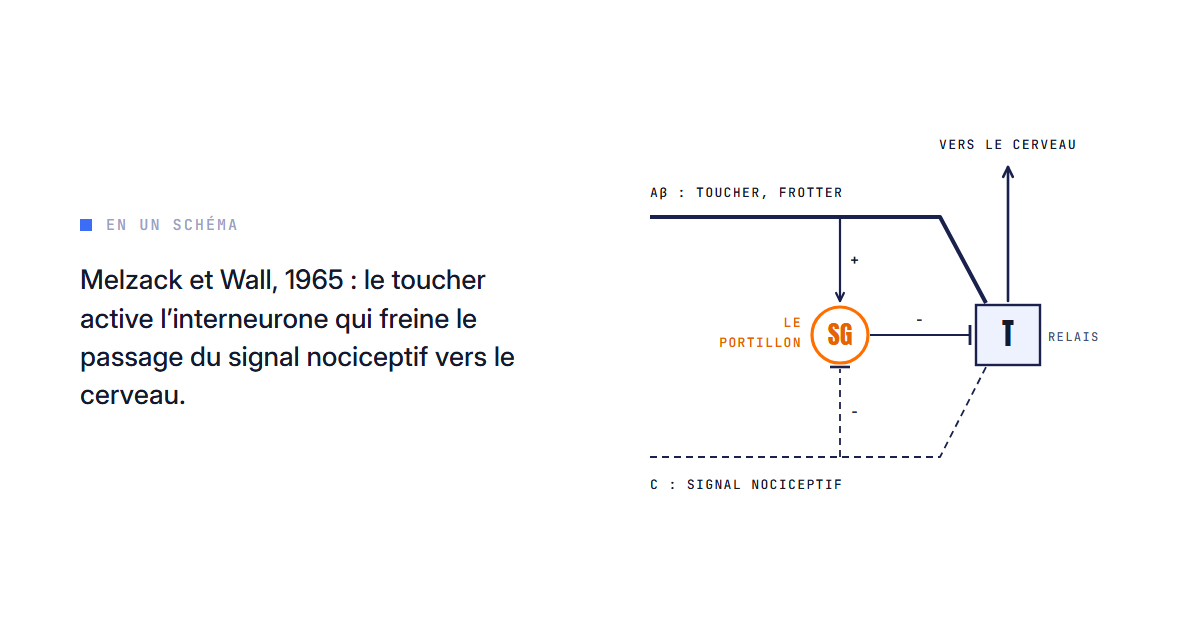
The gate control theory, published in 1965 by Ronald Melzack and Patrick Wall, proposes that the activity of the large touch fibers, the ones your hand recruits by rubbing, slows down in the spinal cord the transmission of nociceptive signals coming from the same area (Melzack and Wall, 1965; Purves et al., 2004, ch. 9). Rubbing modulates what travels up to the brain, while you rub. The theory says nothing about what happens once the hand is removed.
In our article on the tickle that fades after thirty seconds of pressure, the gate was one of four mechanisms, applied to tickling by extrapolation. It deserves an article of its own: it is probably the most cited theory for explaining why a resting hand soothes, and one of the most stretched.
1965: the gate control theory against the idea of a direct line
The dominant idea, the specificity theory whose history Moayedi and Davis (2013) trace, held that a noxious stimulus follows a dedicated line to a brain center, with the feeling faithfully tracking what happens. Melzack would later sum up what had to be left behind: a simple, one-to-one relationship between damage and sensation (Melzack, 1999).
The data were jamming, Mendell (2014) recalls: few sensory neurons responded selectively to intense stimuli, whereas the small fibers of a nerve had to be activated for a stimulus to be described as unpleasant enough to hurt. Melzack and Wall proposed answering this with what was then a brand-new mechanism, presynaptic control: slowing a message before it even passes from one neuron to the next.
Large fibers, dorsal horn, interneurons: the gate mechanism
In the dorsal horn of the spinal cord, where the sensory fibers arrive, transmission neurons receive the small fibers, which carry nociceptive signals, and the large myelinated touch fibers. Interneurons of the substantia gelatinosa act as the gate (Melzack and Wall, 1965). The large fibers tend to close it, the small ones to open it, and their balance sets what passes on to the brain (Mendell, 2014; Braz et al., 2014).
These large fibers originate from the cutaneous mechanoreceptors, including the Meissner and Pacini corpuscles, which are very sensitive to anything moving on the skin: your hand on the elbow produces exactly this sliding, this constantly changing pressure. Textbooks today describe tactile fibers that activate local inhibitory interneurons, which in turn slow the nociceptive projection neurons (Purves et al., 2004, ch. 9). These inputs also feed the sensorimotor loop continuously.
The third piece often disappears from citations: descending pathways, coming from the brain, that change how the gate is set (Mendell, 2014). We have since learned of brainstem centers, including the periaqueductal gray, that facilitate or inhibit transmission in the dorsal horn, and through which the person's context and expectations weigh in (Purves et al., 2004, ch. 9). What travels up to the brain also depends on what the brain sends down.
Sixty years later, what remains of this drawing?
What was confirmed, what has been corrected since 1965
The diagram was challenged early. In humans, Nathan and Rudge (1974) electrically stimulated the large fibers of a nerve without changing the sensations carried by the C fibers alone, and judged their results incompatible with the theory. Wall himself published a re-examination and a restatement of his model (Wall, 1978). Mendell settled it in 2014: "the model is not correct in detail". The single interneuron of the drawing gave way to an ever-longer list of distinct populations (Braz et al., 2014).
The general idea, for its part, has held. In mice, Duan and colleagues (2014) genetically identified inhibitory neurons in the spinal cord that are needed to stop touch fibers from activating the neurons of mechanical nociception. In awake humans, a touch applied at the same time as a nociceptive laser stimulus reduces the sensation (Mancini et al., 2014) and reduces a blink reflex generated by the brainstem, which places the braking, for the authors, probably below the cortex (Mancini et al., 2015).
One last study complicates the picture, and it is the one we prefer. In the primate, Davidson and colleagues (2009) recorded neurons rising from the spinal cord to the thalamus: scratching inhibited them when an itch-inducing substance activated them, but not during their spontaneous activity, nor under a nociceptive stimulus. Itch and tickle are two different things, but anyone who has felt a light tickle make them want to scratch will recognize the idea: the same gesture brakes or lets through depending on the state of the circuit.
What is claimed | Where it was shown | Level of evidence |
|---|---|---|
Touch slows nociceptive transmission in the spinal cord | Mouse (Duan, 2014) | Established in animals |
A simultaneous touch reduces nociceptive sensation | Awake human (Mancini, 2014; 2015) | Established, during contact |
The 1965 wiring | Reviews (Mendell, 2014; Braz, 2014) | Corrected in detail |
The braking depends on the state of the circuit | Primate (Davidson, 2009) | Established for itch |
An effect that lasts after contact | None of these studies | Not demonstrated |
From the gate to Melzack's neuromatrix
For Melzack, the major contribution of the gate lies in the perspective: it forced us to see the brain as an active system that filters and modulates what it receives, and the dorsal horn as a place of modulation rather than a passive relay (Melzack, 1999). He extended the idea with the neuromatrix, a widely distributed brain network that integrates multiple inputs and produces an output, the neurosignature. Sensory input is only one of the influences there, and a neurosignature can even arise without it (Melzack, 2001).
Melzack himself presented it as a proposal. It nevertheless shifts the question: if tactile input is only one voice among others, making it speak louder for a few minutes does not change what the system will produce the following week.
So why does the gate come up so often to justify what happens under the hands?
Manual techniques and gate control theory: what it lets you claim
The appeal is understandable: a named mechanism, that fits in one drawing, for an effect everyone has felt in their own elbow. Any manual technique that soothes in the moment finds a ready-made explanation there. What the theory lets you claim is nonetheless precise: tactile stimulation on an area, or very close to it, can modulate the transmission of that area's nociceptive signals while it is happening, and probably for a short moment afterward. The human experiments measure a simultaneous touch, nothing beyond. You can use it to explain why a person feels more at ease at the end of a session, provided you stop there.
What gate control theory does not let you claim
It says nothing about a lasting change. When the hand leaves, the balance is redrawn with the inputs that remain, as your elbow showed you. None of the studies cited here measures an effect of rubbing at twenty-four hours.
This is where the immediate before and after traps everyone, us included, for years: a person who feels better on the way out, the gate is enough to explain it, without the system having learned anything. The duration of a stimulation's effect is measured, it is not deduced from how it feels in the moment. In the test, stimulation, retest principle, the retest that counts comes the following week, when nothing was stimulated just before. Reading where the body is in the dark and switching an input back on can produce an effect the same day; making it hold is built through programming, and judged on a before and after looked at three weeks later.
Our prediction, for you to check yourself: rub an area, measure its sensitivity to a standard pressure during the rubbing, at ten minutes and the next day, against the opposite side left alone. The difference should be clear during contact and then fade within minutes; if it held the next day, measured blind, the gate alone would no longer explain it.
The questions the gate leaves open
We don't know what share belongs to spinal filtering and what share to descending controls in a simple rub, a share that probably varies from person to person. We also don't know whether tactile stimulations repeated over weeks lastingly change the way a system reads an area; only a study with a retest at a distance will say.
Rubbing closes the gate for the length of the gesture. What still holds the following week, only the retest can show.
👉 I want to intervene in the right place
Frequently asked questions about gate control theory
What is Melzack and Wall's gate control theory?
Published in 1965, it proposes that the large touch fibers slow, in the dorsal horn of the spinal cord, the transmission of nociceptive signals, under the control of the brain.
Why does rubbing a spot you just bumped calm the sensation?
Rubbing activates the large fibers of the skin's mechanoreceptors, which recruit inhibitory interneurons in the spinal cord, during contact.
Is gate control theory still valid?
Its principle has been confirmed in animals and in humans. Its 1965 wiring has been corrected, and Melzack himself extended it with the neuromatrix.
Can an effect obtained by a manual technique last thanks to the gate?
The theory describes a modulation during stimulation, nothing more. To know whether anything holds, you need a retest at a distance, ideally the following week.
By the LabO RNP team
LabO RNP is neither a medical nor a paramedical structure. Our approaches are added to a course of care, they never replace it.
References
Melzack R, Wall PD. Pain mechanisms: a new theory. Science. 1965;150(3699):971-979. doi:10.1126/science.150.3699.971. PMID 5320816.
Purves D, Augustine GJ, Fitzpatrick D, et al. Neuroscience, 3rd ed. Sunderland (MA): Sinauer Associates; 2004. Chapter 9 (nociception).
Moayedi M, Davis KD. Theories of pain: from specificity to gate control. J Neurophysiol. 2013;109(1):5-12. doi:10.1152/jn.00457.2012. PMID 23034364.
Melzack R. From the gate to the neuromatrix. Pain. 1999;Suppl 6:S121-S126. doi:10.1016/s0304-3959(99)00145-1. PMID 10491980.
Mendell LM. Constructing and deconstructing the gate theory of pain. Pain. 2014;155(2):210-216. doi:10.1016/j.pain.2013.12.010. PMID 24334188.
Braz J, Solorzano C, Wang X, Basbaum AI. Transmitting pain and itch messages: a contemporary view of the spinal cord circuits that generate gate control. Neuron. 2014;82(3):522-536. doi:10.1016/j.neuron.2014.01.018. PMID 24811377.
Nathan PW, Rudge P. Testing the gate-control theory of pain in man. J Neurol Neurosurg Psychiatry. 1974;37(12):1366-1372. doi:10.1136/jnnp.37.12.1366. PMID 4449001.
Wall PD. The gate control theory of pain mechanisms. A re-examination and re-statement. Brain. 1978;101(1):1-18. doi:10.1093/brain/101.1.1. PMID 205314.
Duan B, Cheng L, Bourane S, et al. Identification of spinal circuits transmitting and gating mechanical pain. Cell. 2014;159(6):1417-1432. doi:10.1016/j.cell.2014.11.003. PMID 25467445.
Mancini F, Nash T, Iannetti GD, Haggard P. Pain relief by touch: a quantitative approach. Pain. 2014;155(3):635-642. doi:10.1016/j.pain.2013.12.024. PMID 24361816.
Mancini F, Beaumont AL, Hu L, Haggard P, Iannetti GD. Touch inhibits subcortical and cortical nociceptive responses. Pain. 2015;156(10):1936-1944. doi:10.1097/j.pain.0000000000000253. PMID 26058037.
Davidson S, Zhang X, Khasabov SG, Simone DA, Giesler GJ. Relief of itch by scratching: state-dependent inhibition of primate spinothalamic tract neurons. Nat Neurosci. 2009;12(5):544-546. doi:10.1038/nn.2292. PMID 19349977.
Melzack R. Pain and the neuromatrix in the brain. J Dent Educ. 2001;65(12):1378-1382. doi:10.1002/j.0022-0337.2001.65.12.tb03497.x. PMID 11780656.
Read next
Definitions of the Sensorimotor Loop: Fundamental Principles of Postural Control
Learning Pyramid and Functional Neurology: The Neuromechanics the Diagram Simplifies
Learning pyramid and functional neurology: brainstem, cerebellum, proactive and retroactive reflex stability, the neuromechanics behind the diagram.
Read the article Definitions of the Sensorimotor Loop: Fundamental Principles of Postural ControlDale's Pyramid: where the percentages in the learning pyramid come from
Dale's Pyramid: Edgar Dale never published the percentages (10% read, 90% taught). Their real origin, the rebuttals and what research says.
Read the article Definitions of the Sensorimotor Loop: Fundamental Principles of Postural ControlThe Pyramid of Learning by Williams and Shellenberger: the 5 levels, their origin and their limits
Pyramid of Learning by Williams and Shellenberger: the 5 levels, the 22 skills, its origin (Taylor and Trott, 1991) and its limits.
Read the articleReady to read the loop before the movement?
The RNP system is meant to be read, targeted and tested from your next assessment. Start with the member space, for free.