Podcast 1/4h Neuro
Physical activity and ADHD in children: moving to live better
Physical activity helps children with ADHD focus and regulate better. A progressive, evidence-based 12-week plan you can start tomorrow.
The RNP training space, free for life
Get access to RNP training, no strings attached.
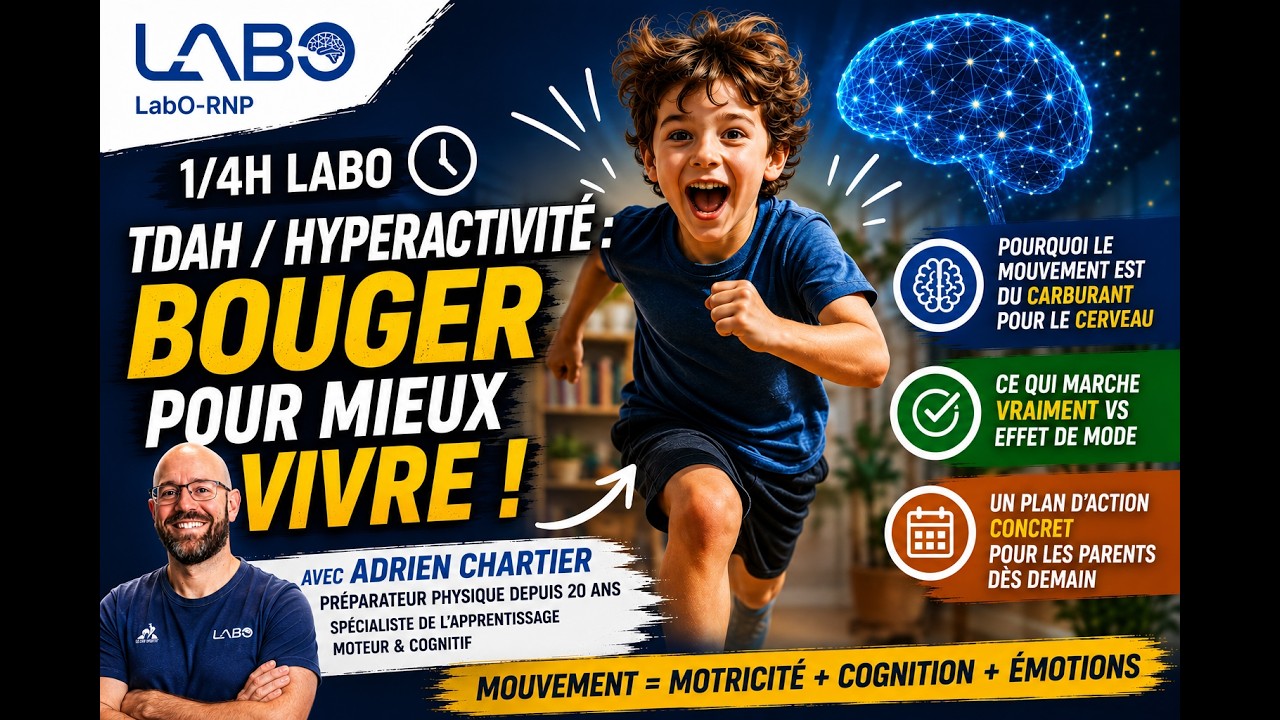
1/4h LabO #250, Watch the episode on YouTube
Physical activity changes the game for children's ADHD. Adrien Chartier, a physical trainer for more than twenty years and co-founder of Labo RNP, sums it up in one sentence: we send our children to two hours of homework and thirty minutes of sport on Wednesday, and it should be the other way around. Here is the neurological mechanism, how to judge approaches by their level of evidence, and a progressive twelve-week plan to start tomorrow.
You may recognize your child in these scenes
You may recognize your child in these scenes. He can't sit still, even in front of a cartoon: he fidgets on the couch, goes in front, goes behind, keeps moving. Homework? Two hours of battle for twenty minutes of real work. Yet he knows his lessons, he would go fast if he could concentrate without getting worked up. He forgets what you've just told him. He explodes over nothing, out of patience, unable to take the slightest frustration. In the evening, exhausted, he can't fall asleep. And at school, you keep being told he disrupts, he chatters, he bothers the others.
Adrien Chartier, a physical trainer for more than twenty years and co-founder of Labo RNP, sums it all up in one sentence. We send our children to two hours of homework and thirty minutes of sport on Wednesday. It should be the other way around. Movement acts as a neurological response before it is a leisure activity. This article shows you this mechanism, teaches you to judge approaches by their level of evidence, and gives you a progressive twelve-week plan you can start tomorrow.
Movement, the neurological fuel of a child's brain
The brain doesn't make movement out of nothing. It is built on sensory inputs. The more a child moves, the more he informs his brain about balance, body position, vision. And the better informed he is, the better he organizes himself, concentrates, and ends up regulating himself. When the body doesn't send enough information, the brain glitches. That is where agitation, inattention and opposition are born.
The three sensory inputs
Three systems feed the brain permanently. The visual one first: what the child observes and the way his eyes pick up the information around him. The vestibular one next, housed in the inner ear, the spirit level of the human body: it manages balance, body position, opening or closing, the endurance of the back and neck muscles. The somesthetic one finally, proprioception and touch: is it pleasant to be touched, do I know how to use my body in space, am I very ticklish.
Why exploration matters more than anything else
Not all movements are equal. Moving between four walls, in a house, doesn't have the same impact as moving out in nature, in a forest. A rich environment brings more information, and better quality information. The rule fits in one word: exploration comes first. The child has to explore, because it is this richness of information that makes his brain more available.
How to read the evidence: not all approaches are equal
Before believing in a lever, you need to know what it weighs. Labo RNP rates each study. Five stars and green: it's solid. Four stars: good and solid, several strong and converging studies confirm the result. Three stars and orange: moderate, a few clinical trials exist but the results remain partial or heterogeneous. Two stars, or even just one: limited or weak, based on preliminary or observational studies, with small samples, sometimes biased or undermined by conflicts of interest.
The stance is deliberate. We tell you what we know and what we still don't. The goal is not to sell you anything, but to give you a complete and overall view, so that you judge each lead instead of blindly buying into it.
Sleep and screens: the foundation before everything else
Without sleep, no pillar holds. And on the screen side, we touch on the clearest piece of evidence in this whole presentation. These two foundations are rated at the good level.
Sleep
A 2023 meta-analysis, covering behavioral interventions supported by parents, shows a moderate effect on sleep disorders, with moderate certainty: better sleep, less agitation, fewer difficulties during the day. Four habits to put in place right away. Fixed routines, same bedtime on weekdays and weekends, an hour's difference at most: the child's brain is under construction, it demands security, and unstable schedules tip it into survival mode. Screens off at least an hour before bedtime, two hours ideally. A cool bedroom, between 18 and 19 degrees (64 to 66 degrees Fahrenheit), dark, quiet, with no screen at all. And a soothing ritual of at least thirty minutes of winding down: reading, a lukewarm shower, dim light.
Screens
The 2023 meta-analysis followed 81,234 children. Beyond two hours of screen time a day, the risk of ADHD symptoms is multiplied by 1.5. The rules that work are simple. No screen in the morning before school, when the body needs to wake its energy, ideally through twenty minutes of walking outside. No screen at the table, we focus on the meal and the family. Stop one hour before bedtime. No screen in the bedroom. Not everything has to be banned, though: co-viewing, watching together, beats solo viewing and even improves the child's abilities, and certain video games feed mental construction, far from the war games that come too early, of course.
Nutrition: aim for what's solid, avoid miracle diets
Nutrition matters, provided you don't fall for the miracle diet or the trendy food. Overall, we are at moderate levels, with one robust exception.
What is moderate or weak
Omega-3s get talked about a lot. Good for health, yes, but for ADHD the studies only find a small effect, useful only after four months of supplementation: a 2023 meta-analysis pooling 22 studies on 1,789 children. On the deficiency side, iron, zinc, magnesium, iodine and omega-3s are checked when there is clinical suspicion. The rule allows no exception: have a doctor measure them, never self-supplement without a prior blood measurement.
What is robust
Sugar and junk food, on the other hand, give a clear result. Brioche bread or a Nutella baguette in the morning, McDonald's, ultra-processed products: a 2024 meta-analysis, among many others, establishes a robust association with worsening symptoms. Sugary drinks are to be limited without hesitation. A child has no reason to live with soda or syrup in his water bottle, especially when he is already very agitated.
The sport that really works: open or closed, and at what dose
We arrive at the heart of the matter, and the evidence is recent and good. In 2025, 16 randomized trials show a moderate effect on attention, working memory and inhibition. In 2023, 24 studies on 914 children confirm the effect on memory, inhibition and flexibility. In 2024, a Bayesian meta-analysis of 33 studies establishes that the more the child moves, the stronger the effect, up to certain plateaus. Getting the child to move is no longer a belief. But the devil is in the details, because not all sports act in the same way.
Closed sports
Running, swimming, cycling, treadmill, archery: repetitive movements in a predictable environment. This regularity is good for working memory.
Open sports
Tennis, soccer, judo, badminton, climbing, dance: the environment changes constantly and demands constant adaptation. This adaptation works on inhibition and flexibility. Depending on your child's difficulties, you can aim for one family or the other, and sometimes combine the two.
The dose that works
The studies converge: three sessions a week minimum, of 30 to 45 minutes, at moderate to intense effort, for 8 to 12 weeks for lasting effects. There's no need for the child to blow himself up, moderate effort is enough to act on his executive functions and his behavior. One last point to keep in mind: school sport, one hour a week, is useful but not therapeutic. Believing it's enough because the child does sport at school is a mistake.
The sensory pillar and balance: a ground to prepare
ADHD comes with a particular sensory profile, on solid grounds: these children show significantly more sensory processing difficulties than a neurotypical child.
Hypersensitive and hyposensitive
The child who startles, the hypersensitive one, covers his ears in noisy places, can't stand certain textures, labels or seams, seeks calm, avoids unexpected physical contact and can explode after a school day. The child who seeks, the hyposensitive one, touches everything, moves constantly on his chair, speaks loudly, puts the music on full blast, doesn't seem to notice his bruises or injuries, and needs to be stimulated constantly to stay attentive. The same child can be hypersensitive in some areas and hyposensitive in others.
Balance, an often forgotten foundation
Before running, you have to stand upright. Labo RNP ran a study in a rural school on 36 children. On the walking test, a strip on the floor 10 cm wide and 5 m long to cross without losing balance, 100% of the children showed a deficit. The higher the deficit, the more marked the academic difficulties: reading on the fluency test (a maximum of words read in one minute) and graphic writing (reproducing shapes from a model). The program, about 5 minutes a day of simple vestibular exercises doable in class, over 10 to 12 weeks, improved reading and writing. The rating remains moderate, in all honesty, because the study is not yet published and no meta-analysis consolidates these results. A promising approach, with no validated standard to date.
An honest overview of sensory approaches
Targeted physical activity rests on solid meta-analyses: it is the most robust lever, go for it without hesitation. Ayres sensory integration, used by psychomotor therapists and occupational therapists, is rated moderate for ADHD, with good evidence mainly on the autism side. Work on persistent archaic reflexes remains limited: correlations are established for the ATNR and the Moro, the two most studied reflexes, but rigorous trials are still lacking. Global methods such as Brain Balance or Melillo are rated weak: Melillo's flagship studies were retracted in 2025, and his hemispheric theory, unvalidated, is filed on the pseudoscience side.
The 12-week physical activity plan, and when to consult
You don't do everything at once, nor the same thing for every child. You set up a framework that holds, built in as a routine.
Month 1: set up the foundation
Five minutes of work on balance and proprioception every morning. A structured sleep routine. Screen limits, none in the morning, stop one hour before bedtime. And no new sport demands in this first phase.
Month 2: add the sport
Three sessions a week of an open sport: judo, tennis, soccer, climbing, dance. You keep everything that already works, and you add five minutes of breathing or meditation in the evening.
Month 3: consolidate and evaluate
You maintain all the foundations. You look at what works for this child, you keep what functions, you adjust the rest, and you take stock as a family of what has changed day to day. Twelve weeks is the minimum threshold identified in most studies for lasting changes. Below that, you can't say you've really tried.
The evaluation grid
Five questions, at three points: before starting, at 6 weeks, at 12 weeks, rated from 1 (very difficult) to 5 (very easy). Sleep: does he fall asleep easily, does he sleep without waking. Concentration: does he hold on a calm activity, homework, reading or play, without dropping out. Coordination and balance: is he comfortable in motor games, does he fall less, with a simple one-leg test or a ball throw over 20 attempts. Sensory tolerance: does he tolerate noise, crowds, certain textures or lights. Emotional regulation: how many outbursts a day, does he recover quickly.
When to consult
You can start on your own if there is no diagnosis, just everyday discomforts, on two conditions: that the child goes along with the framework and that the family can hold twelve weeks of consistency. Having symptoms doesn't mean having ADHD; nutrition and screens weigh heavily on these signs. On the other hand, you consult if the child is suffering (anxiety, lasting sadness, feelings of worthlessness), if the family is wearing out, if school is in great difficulty or if the child has been excluded, or if a diagnosis has already been made. In that case, movement complements medical follow-up, it doesn't replace it. At the slightest doubt, turn to a pediatrician, a child psychiatrist, a pediatric neurologist, a neuropsychologist for assessments, or to the CPTS and PCO in your area, which support diagnostic pathways (PCOs concern children under 7, or even under 12 for some).
FAQ
What are the signs of ADHD?
A child who can't sit still even in front of a cartoon, who fidgets constantly, homework that turns into two hours of battle for twenty minutes of work, immediate forgetting, explosions over nothing, difficult sleep with evening meltdowns, and a school that reports he disrupts and bothers the others.
Why is movement useful for ADHD?
Because the brain builds motor skills from sensory inputs (vision, vestibular, somesthetic). The more the child moves, the more he informs his brain, the better he organizes himself, concentrates and regulates. Recent meta-analyses confirm an effect on attention, working memory, inhibition and flexibility.
What are the best sports for a child with ADHD?
Open sports (judo, tennis, soccer, climbing, dance), where the environment changes and demands permanent adaptation. They beat closed sports for concentration and inhibition. Closed sports (running, swimming, cycling, archery) remain good for working memory.
Individual or team sports for an ADHD profile?
The axis that matters opposes open to closed, not individual to team. Useful open sports cover both families: judo and tennis are practiced individually, soccer as a team. Choose according to the adaptation you want to work on.
What tool can help my child with ADHD day to day?
The five-question self-evaluation grid (sleep, concentration, coordination and balance, sensory tolerance, emotional regulation), rated from 1 to 5 at three points (start, 6 weeks, 12 weeks), paired with the progressive twelve-week plan.
Related articles
More episodes
The same take on movement, from three other angles of the 1/4h Neuro.
Podcast 1/4h Neuro
Functional breathing: the science of your breath, a superpower you can steer
Functional breathing sends the right signal to your nervous system: breathe through your nose, boost your CO2 tolerance and gain daily energy.
Read the article Podcast 1/4h Neuro3 proprioception exercises to improve ankle mobility (and find out if they really work on you)
Do your ankle exercises really work? Two home tests, a wall and a pen, and three proprioceptive stimulations to check it on yourself.
Read the article Podcast 1/4h NeuroNeurocognitive training: stop tinkering with it, start building it
Neurocognitive training is programmed like strength: target a quality, measure a starting point, dose the load and transfer it to the field.
Read the articleReady to read the loop before the movement?
The RNP system is meant to be read, targeted and tested from your next assessment. Start with the member space, for free.