Podcast 1/4h Neuro
Sports Vision Training: What 14 Athletes Really Gained After a Level 1 Cycle
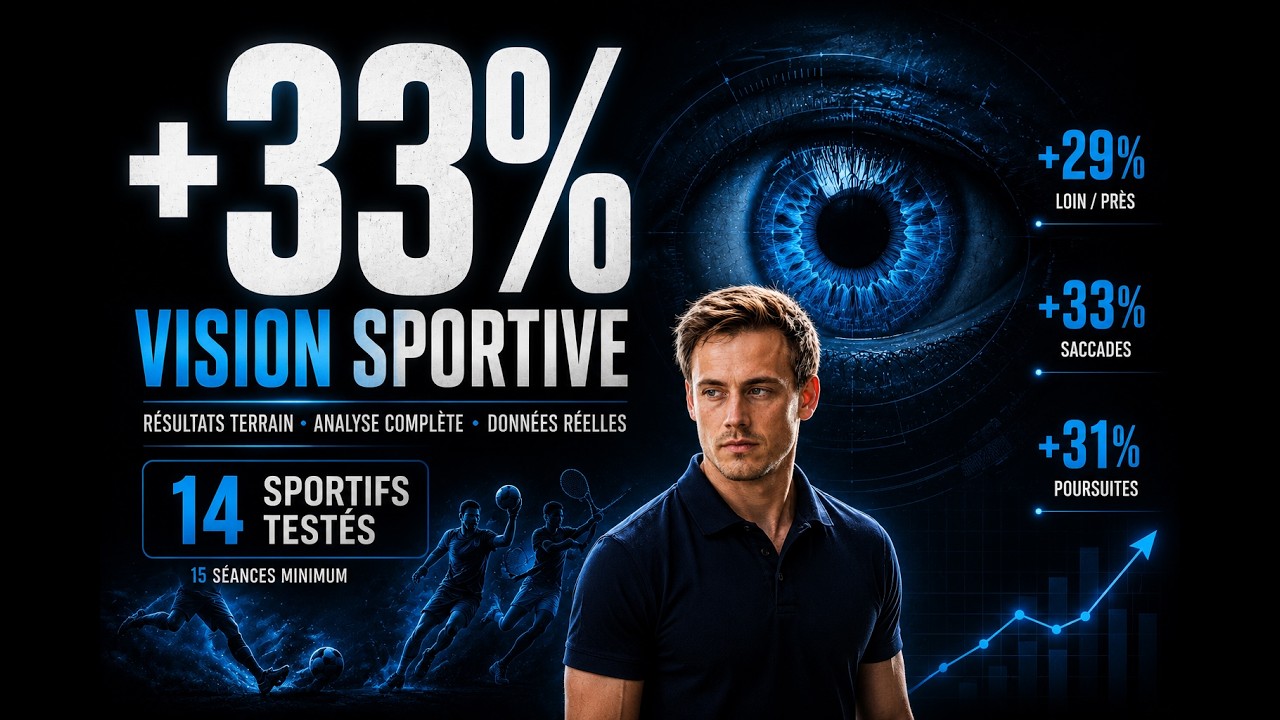
Sports vision training: 14 athletes tested, +29% far-near, +33% saccades, +31% letter ball. Results in figures, exercises to follow.
The RNP training space, free for life
Get access to RNP training, no strings attached.
1/4h LabO #249, Watch the episode on YouTube
"I feel like I lose less time looking around me." An athlete in the group blurted this out, raw, after his sessions. Everyone keeps saying that sports vision training boosts performance. Almost nobody shows what it really delivers, with numbers to back it up.
So we took a close look. 14 athletes, a shared visual program, at least 15 sessions each, since spring 2024. Soccer, handball, tennis, badminton. A score recorded at every session. At the end, we compared before and after. And we asked ourselves the only question that matters: what do the data really say?
One clarification before we get into it, stated right away so there is no misunderstanding. What follows is a pre-post test run on a group of athletes being followed, not a scientific study in the strict sense. You will read trends, percentages, correlations. Take them for what they are: field feedback, with the caution that goes with it.
The level 1 sports vision training protocol: 14 athletes, one common foundation
The program is designed as a common base for all sports that rely on information intake. Whatever your sport, if you have to read a situation with your eyes before acting, this foundation concerns you. 14 athletes have followed it since spring 2024, in soccer, handball, tennis and badminton, over 2024 and the start of 2025.
In practice, two formats. A quick 12-minute sequence when time is short: warm-up, cool-down, and three standardized exercises in the middle. And the full 25-minute sequence: warm-up, 14 exercises, cool-down. The target rhythm: at least 3 times a week, with a goal of at least 15 completed sessions per athlete.
The idea doesn't come out of nowhere. It comes from baseball, where quite a few programs of this kind have been built to win points at the plate and push up batting statistics. We had already set it up with handball in Strasbourg, in the late 2010s, before rebuilding it here with this group of athletes.
Of the 14 exercises in the full sequence, three serve as progress benchmarks: far-near, saccades and the letter ball. These are the three skills that are easy to standardize, and therefore the ones you can track session after session with numbers. The other exercises are there to support progress on these three.
The three visual skills trained and measured
Three skills, three benchmarks. Here is what each one works on, and why.
Far-near
Far-near is the ability to shift quickly from distance vision to near vision. Behind it, two ocular mechanisms. Accommodative flexibility, meaning the focus that changes from one plane to another. And vergence, meaning the convergence-divergence of the two eyes as what you fixate on gets closer or farther away. To standardize the distances during the exercise, we use charts.
On the field, it speaks fast. In soccer, you spot a teammate far away and then instantly come back to the ball at your feet. In handball, you watch the goalkeeper's positioning and then look up close at your pivot or your back-court player; on a counterattack, the winger who takes off far away, then the closer pass to your center back. In tennis and badminton, you observe the opponent's position at the back of the court, then you focus on the ball or the shuttlecock for your pursuit and your stroke. Every time, the same move: I look far, I look near, I vary the depths of my information intake.
Saccades
A saccade is a jump. Rapid eye movements from one target to another, without moving the head, to focus the work on the muscle groups around the eyes. The goal is simple: gain visual scanning speed and clarity during movement.
Be careful not to confuse it with pursuit. In a pursuit, you follow a target and never take your eyes off it. In a saccade, you jump from one fixation point to another very quickly, without being "aware" of what happens between the two points. It's a shortcut to visualize the difference, but it holds. In soccer, think of a Kimmich-type midfielder scanning the players around him to decide who to pass to. In handball, quickly detecting a free zone or an unmarked teammate on the wings. In tennis and badminton, glancing at the opponent's positioning and then coming back to the ball or the shuttlecock without losing time.
The letter ball
A letter ball is dead simple: a ball marked with numbers and letters that you can read during a pursuit. The move: you throw it against a wall, you identify the mark, you follow it with your eyes, then you catch it or juggle it while reading the letter that is going to touch the palm of your hand as you recover it.
What it works on: eye-hand coordination, visual processing reactivity, and pursuit, your ability to follow a very precise point. All of it in focal vision, where you place your focus point, as opposed to peripheral vision. In soccer, it helps handle a ball coming from above while keeping an eye on a defender. In handball, it helps receive the ball under pressure while quickly reading the number called out. In tennis and badminton, it helps grasp the trajectory and spin of the ball or shuttlecock while integrating a visual cue. It all comes down to one sentence: do a pursuit and take in information at the same time.
How progress was measured (methodology and limits)
The tracking relies on a simple tool: an Excel file fed by a Google Form completed after each session, where the athletes enter their data. From there, for each skill, we calculated the difference between the final scores and the initial scores, relative to the starting value. This gives an average percentage of progress.
Then we checked that these gains held up statistically. A significance test with a paired t-test, an examination of the dispersion, and a calculation of the correlations between skills. Deliberately simple indicators: mean, standard deviation, correlation. A mini statistical study, to see in numerical terms what it really gave.
The disclaimer, we repeat it because it matters. These are the data of a pre-post test on 14 athletes. No control group, no randomization, no double-blind protocol. Nothing was validated by an ethics committee or published in a peer-reviewed journal. The results must be interpreted with caution and not generalized beyond this group. The aim is to share a glimpse of the progress observed, to feed your thinking and your avenues for improvement, not to sell you irrefutable proof.
The results: 29%, 33% and 31% gains
All three skills come out significant on the test: far-near is highly significant, and saccades and the letter ball are significant too. Here are the average gains.
Far-near: about 29% gain. The athletes switch faster between distance vision and near vision. In soccer and handball, they reported spotting an unmarked teammate faster before coming back to a dribble or a closer shot. In tennis and badminton, they moved faster, and effortlessly, from seeing the opponent at the back of the court to the ball or shuttlecock to be hit.
Saccades: about 33% gain. A third better in visual scanning speed. In soccer, this translates into a faster analysis of where teammates and opponents are, more information intake in the moments before receiving the ball, and slightly faster decisions. In handball, scanning the wing or the back court while staying aware of the ball. In tennis and badminton, spotting the other player's posture and coming back to your shot in the blink of an eye.
Letter ball: about 31% gain. Notable progress in one-handed coordination and reactivity. In soccer, better control of a ball coming from above while spotting a possible opposing press. In handball, recovering the ball with one hand and following up quickly after taking in information through peripheral vision. In tennis and badminton, reading the trajectory and acting fast on a reflex volley at the net. In short, eye-hand and eye-racket coordination.
What the correlations reveal: specific skills
We pushed the analysis one notch further with Pearson correlations between the three lists of results. A correlation, here, measures whether progressing on one skill goes hand in hand with progressing on another. The figures: far-near and saccade at 0.28 (weak to moderate), far-near and letter ball at 0.48 (moderate), saccade and letter ball at 0.41 (moderate).
The weakest one, the 0.28 between far-near and saccade, is the most telling. It indicates that a big improvement in saccades doesn't necessarily predict a big improvement in far-near. Logical, when you think about it. Far-near calls on convergence-divergence, whereas saccades draw on other abilities and other muscle groups around the eyes. Each skill is specific to what you are trying to work on.
The correlations involving the letter ball, a little higher, suggest a relative transversality between these tests, but it remains moderate. So we observe progressions that are explained mostly by qualities specific to each test, with still a common trend for some athletes. Practical conclusion: you can be precise. You can target training according to the real needs of the athlete in front of you, rather than banking on an automatic transfer from one skill to another.
Athletes' feelings and outlook (toward a level 2)
Beyond the numbers, the athletes gave feedback after each session, both on the execution and on what they then observed in their discipline. Three effects come up again and again. Better decision speed in team sports. Fluidity and consistency in information intake among racket players, tennis and badminton. And increased confidence. The "I feel like I lose less time looking around me" sums up the shared sensation well.
The logical next step is a level 2. The idea: add constraints to get closer to the real conditions of the sport, distractors, timing, multiple movements. Level 1 isolates and standardizes each skill; level 2 puts it back into the noise of the game.
And the reminder, one last time. These 29%, 33% and 31% are significant improvements despite the absence of a strict scientific protocol. It is field feedback, drawn from a tracking tool, to be shared, not proof valid for all contexts. Sports vision remains an underexploited field, and these figures mostly hint at the potential still left to dig into.
FAQ
How does it work?
You follow a visual training sequence, either in the quick 12-minute version (warm-up, three standardized exercises, cool-down) or in the full 25-minute version (warm-up, 14 exercises, cool-down), at least 3 times a week, with a goal of at least 15 sessions. After each session, you fill in a Google Form that feeds an Excel file, which lets you track your scores over time and compare your before and your after.
What do we really control with the eyes?
Several distinct skills. Far-near, your ability to switch between distance and near vision (accommodative flexibility and convergence-divergence). Saccades, those rapid eye jumps from one target to another without moving the head. Pursuit, where you follow a target without taking your eyes off it. And information intake in focal (central) vision as well as in peripheral vision.
Why train the eyes?
Because vision is a performance lever, whether you play soccer, handball, tennis or badminton. In this group, training produced about a 29% gain on far-near, 33% on saccades and 31% on the letter ball, with benefits reported on the field: faster spotting, faster decisions, better coordination, more confidence.
How do you train the eyes as part of sports practice?
Through the three standardized level 1 exercises. Far-near with charts to switch quickly from one plane to another. Saccades to gain visual scanning speed. The letter ball, a ball marked with numbers and letters that you follow and then catch while reading the mark, for eye-hand coordination and reactivity. All of it built into the sequence, supported by the other exercises.
Practical application: in which contexts can you use it?
In all sports that rely on information intake. In soccer, spotting a teammate then coming back to the ball, scanning before the pass, controlling an aerial ball under pressure. In handball, alternating goalkeeper and pivot, scanning the wings, receiving while reading a number. In tennis and badminton, alternating back court and stroke, reading the trajectory on a reflex volley. And to go further, a level 2 with distractors, timing and multiple movements to match real conditions.
Related articles
More episodes
The same take on movement, from three other angles of the 1/4h Neuro.
Podcast 1/4h Neuro
Functional breathing: the science of your breath, a superpower you can steer
Functional breathing sends the right signal to your nervous system: breathe through your nose, boost your CO2 tolerance and gain daily energy.
Read the article Podcast 1/4h Neuro3 proprioception exercises to improve ankle mobility (and find out if they really work on you)
Do your ankle exercises really work? Two home tests, a wall and a pen, and three proprioceptive stimulations to check it on yourself.
Read the article Podcast 1/4h NeuroNeurocognitive training: stop tinkering with it, start building it
Neurocognitive training is programmed like strength: target a quality, measure a starting point, dose the load and transfer it to the field.
Read the articleReady to read the loop before the movement?
The RNP system is meant to be read, targeted and tested from your next assessment. Start with the member space, for free.