Podcast 1/4h Neuro
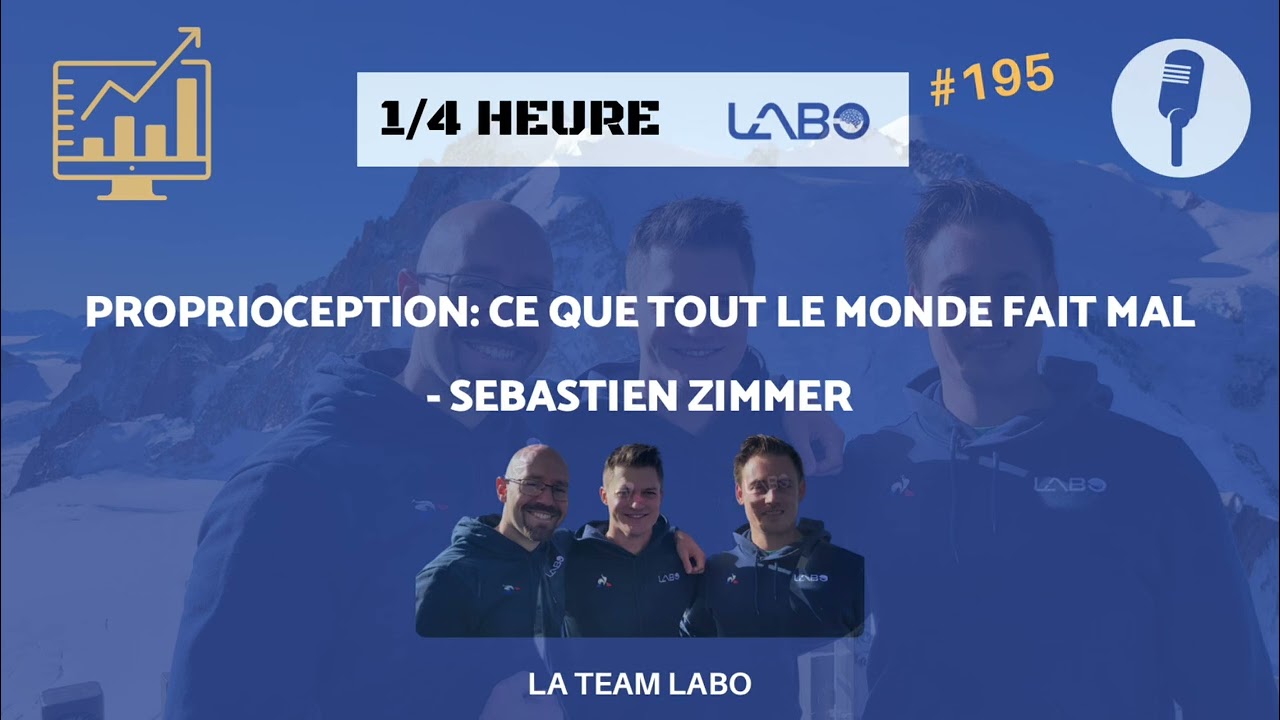
1/4h LabO #195: Proprioception - What Everyone Gets Wrong - Sebastien ZIMMER
Discover why proprioception is often misunderstood and how to improve it effectively with tailored methods.
The RNP training space, free for life
Get access to RNP training, no strings attached.
Introduction to Proprioception
You’ve probably heard that to improve proprioception, all you need to do is perform exercises with your eyes closed or on unstable surfaces. However, this statement is incomplete. In reality, these misconceptions hide a much deeper problem.
Sébastien Zimmer's Journey
Welcome to the quarter-hour LabO, the weekly podcast that popularizes neuroscience. I am Sébastien, co-founder of LabOrNP, and I will share my journey with you.
A Learning Journey
My path began with a degree in STAPS up to the Master’s level. I quickly felt the need to explore disciplines that are rarely addressed in traditional training. So, I traveled and trained in areas such as functional neurology, primitive reflexes, and posturology.
Scientific Collaboration
This quest for knowledge led me to collaborate with a neuroscience lab in Lausanne. Thanks to this collaboration, I was able to connect different disciplines to solid scientific foundations and understand how the nervous system coordinates posture, movement, and performance.
Neuropostural Reprogramming
Together with my colleagues Adrien and Romain, we developed a comprehensive system: neuropostural reprogramming. This system allows us to assess postural imbalances, understand their origins, and propose targeted solutions to optimize performance and prevent injuries.
Proprioception: An Essential Key
Proprioception is one of the keys to our system, but it is often misunderstood. It is the ability of our brain to represent our body in space and time. Every movement, whether catching a ball or lifting a load, depends on this internal representation.
Common Training Mistakes
Unfortunately, traditional methods for working on proprioception are based on misconceptions. Exercises like squats on unstable surfaces or maximum intensity joint rotations do not correct imbalances.
Practical Webinar
If these concepts resonate with you, don’t miss the webinar next Thursday with Adrien and Romain. We will share practical tools that can be directly applied in your professional practice.
What You Will Learn
- Why proprioception is often misunderstood.
- How to assess effectively to avoid common mistakes.
- Practical exercises to apply immediately.
A Specific Training Program
As with every webinar, you will receive a specific training program based on the RNP system, easy to implement and effective for testing these approaches with your clients.
Conclusion
The solutions I will share during the webinar are not theoretical. I first applied them to myself after a knee injury and tested them with my clients. Today, they are used by professionals trained in our system.
To register, follow the link in the bio. It’s free, but places are limited to 100 participants. Remember, move well, but moving with an optimized brain is even better. See you soon!
More episodes
The same take on movement, from three other angles of the 1/4h Neuro.
Podcast 1/4h Neuro
Decoding the Asymmetrical Tonic Neck Reflex - ATNR
Is your child getting tired while writing? Discover how an archaic reflex, the ATNR, can disrupt coordination and learning into adulthood.
Read the article Podcast 1/4h NeuroBrain Performance Is Not About Strength, But Balance
Exhausted but unable to disconnect? Discover how to restore your brain's balance to regain focus and mental energy.
Read the article Podcast 1/4h Neuro1/4h LabO #231 - Why Does Movement Think Before Us?
Discover how perception, not force, is the key to movement. Dive into the paradox of the first step and revolutionize your understanding of the body.
Read the articleReady to read the loop before the movement?
The RNP system is meant to be read, targeted and tested from your next assessment. Start with the member space, for free.