Podcast 1/4h Neuro
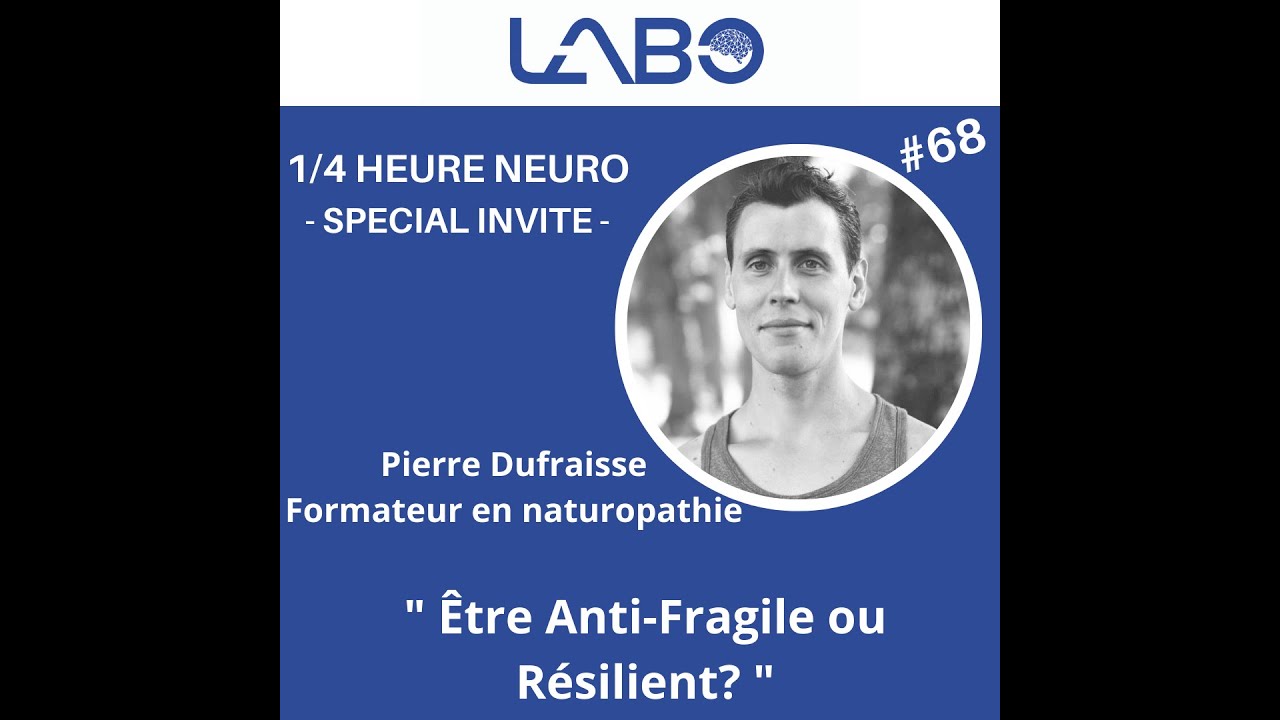
1/4 Hour Neuro #68: "Being Anti-Fragile or Resilient?"
Discover how anti-fragility, a fascinating concept, differs from resilience and how it influences our adaptation to stress.
The RNP training space, free for life
Get access to RNP training, no strings attached.
Introduction: Resilience or Anti-Fragility?
In this episode of "1/4 Hour Neuro", we explore a fascinating concept: anti-fragility, popularized by Nassim Nicholas Taleb, and distinguish it from resilience. Pierre Dufraisse, a specialist in naturopathy and mental and physical preparation, sheds light on this ability of living beings to strengthen in the face of stress and the unexpected, a fundamental notion for understanding our development and adaptation.
Pierre Dufraisse, director of a naturopathy training center, shares his passion for processes of overcompensation in response to stress. His journey, which includes training in tummo yoga (ice baths, cold exposure), has led him to deepen his understanding of anti-fragility, that is, how complex systems and living beings become stronger when subjected to shocks or unpredictable events.
Understanding Anti-Fragility: Beyond Resilience
Pierre Dufraisse emphasizes that the term "anti-fragile" is often misunderstood. Anti-fragility is not a characteristic acquired by following recipes, but an inherent property of living organisms and complex systems. We are all anti-fragile by nature, as we strengthen when faced with challenges, shocks, or stress.
Robustness or resilience, although similar, are concepts that are surpassed by anti-fragility. A robust object can withstand stress up to a certain point, after which it breaks. An anti-fragile system, however, does not simply resist: it improves and becomes stronger after experiencing stress. It is this capacity for continuous improvement that has allowed the complexity of life to evolve over millennia.
To understand anti-fragility, the key concept is volatility. This refers to random and unexpected events that shape our environment and, by extension, life itself. To cultivate this anti-fragility, as Taleb suggests, one must expose oneself to "troubles," unexpected events, temperature shocks (hot, cold), physical efforts, or breath-holding, as these experiences force the body to adapt and strengthen.
hormesis and Progressive Overload: Mechanisms of Improvement
The concept of hormesis, the idea that a low dose of stress can be beneficial, is often misunderstood. It is not about inflicting pain or exceeding one's limits recklessly. Hormesis is synonymous with gain and improvement. If a stress does not lead to improvement, it is simply deterioration, not hormesis.
This logic is similar to progressive overload in sports training: gradually and appropriately applied stress leads to overcompensation and continuous improvement. The living body is designed to adapt and grow in response to these varied stimuli. Without variation in stimuli and loads, the body seeks stability, which no longer promotes improvement.
Memory and Creativity: The Impact of Stress
The process of memorization also illustrates anti-fragility. The hippocampus consolidates memory after a phase of stress, as the adrenaline released during a significant event signals to the body the importance of retaining that information. A car accident, for example, will leave very vivid and detailed memories due to this shock and integration phase.
Similarly, constraint and stress can stimulate creativity. The example of the restaurant world, where every chef is forced to be creative under pressure, strengthens the entire system. It is by stepping out of one's comfort zone and facing the unexpected that new solutions emerge and innovation thrives.
Cold Exposure and Posture: Lessons in Anti-Fragility
Pierre Dufraisse shares a personal anecdote about his experience with cold exposure, particularly through tummo yoga. Cold exposure, far from being torture, should be gradual and tailored. Starting with cold showers and then progressively increasing the intensity and duration allows the body to adapt and become anti-fragile in the face of this constraint.
Posture also plays a crucial role in this capacity for adaptation. The great yoga master Maurice Jaubert taught that good external posture induces internal posture, allowing for better resilience and acceptance of shocks, such as cold. Self-confidence, partly regulated by posture, facilitates the acceptance of the unexpected and challenges.
The group effect and brain prediction are also important factors. The example of "grandmas" who managed to stay in the cold at -27 degrees for an hour, simply because "everyone was doing it," highlights the colossal impact of perception and social environment on our ability to overcome challenges that would seem impossible individually.
More episodes
The same take on movement, from three other angles of the 1/4h Neuro.
Podcast 1/4h Neuro
Decoding the Asymmetrical Tonic Neck Reflex - ATNR
Is your child getting tired while writing? Discover how an archaic reflex, the ATNR, can disrupt coordination and learning into adulthood.
Read the article Podcast 1/4h NeuroBrain Performance Is Not About Strength, But Balance
Exhausted but unable to disconnect? Discover how to restore your brain's balance to regain focus and mental energy.
Read the article Podcast 1/4h Neuro1/4h LabO #231 - Why Does Movement Think Before Us?
Discover how perception, not force, is the key to movement. Dive into the paradox of the first step and revolutionize your understanding of the body.
Read the articleReady to read the loop before the movement?
The RNP system is meant to be read, targeted and tested from your next assessment. Start with the member space, for free.