Podcast 1/4h Neuro
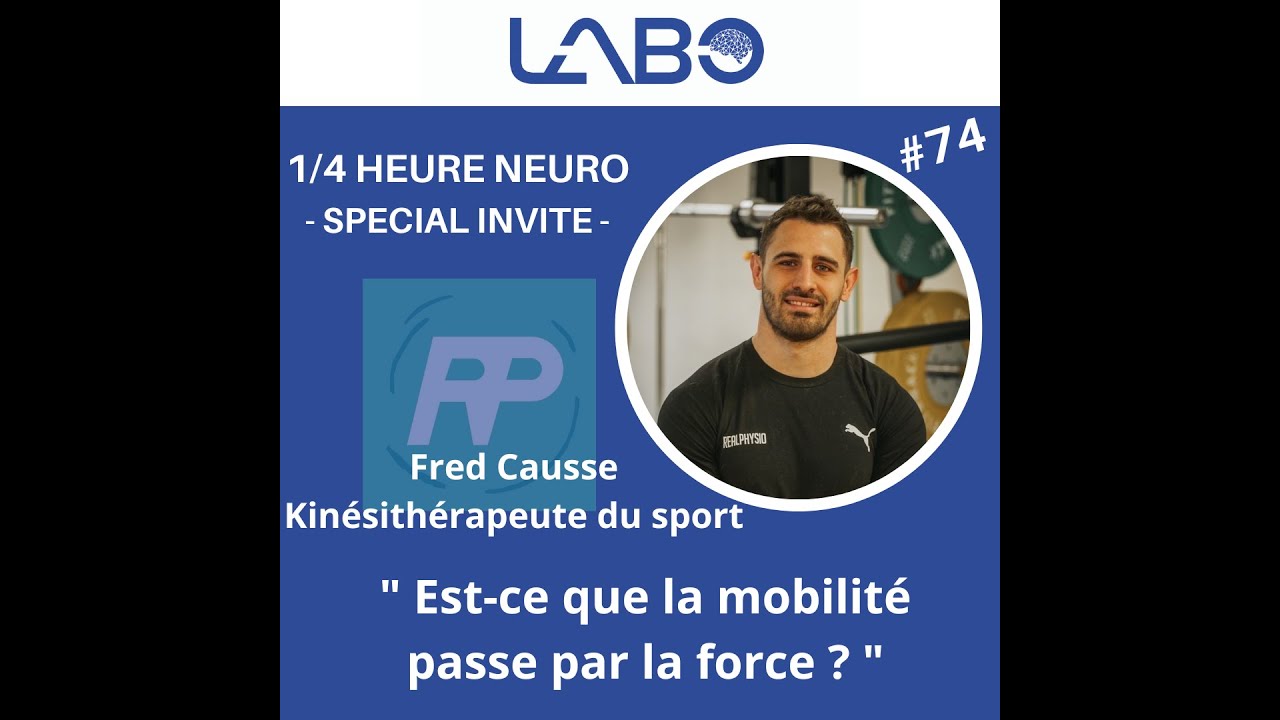
1/4 Hour LabO #74: "Does Mobility Come from Strength?" - Fred Causse
Explore the relationship between mobility and strength with Fred Causse, physiotherapist and physical trainer, in this engaging episode.
The RNP training space, free for life
Get access to RNP training, no strings attached.
Introduction: Mobility, Strength, and Collaboration
This podcast explores the fundamental question of the relationship between mobility and strength, and whether mobility is merely a function of strength work. Fred Causse, sports physiotherapist and physical trainer, guides us through his vision, emphasizing the importance of an integrated approach. He shares his experience as a dual professional in both physiotherapy and coaching, highlighting the nuances of these two fields, often perceived as distinct but actually complementary.
Fred Causse manages a facility in Strasbourg where he works with his team and also provides physical training for judokas, synchronized swimming, and private clients. His approach is adaptable, incorporating individualized programming concepts to optimize results, whether in rehabilitation or sports performance.
Physiotherapy and Coaching: Complementary Approaches
Fred Causse explains that ideally, there should be no difference between physiotherapy and private coaching. However, the reimbursement system in France creates financial constraints that impact the duration and format of sessions. While physiotherapy sessions are limited by Social Security rates, coaching sessions offer more flexibility for deeper and more individualized support.
He compares the French situation to that of other countries like Belgium, where physiotherapists are considering uncoupling from conventions to have more freedom in their practices. Despite these constraints, Fred and his team strive to provide rigorous follow-ups, asking for a small supplement to ensure financial balance and offer programs to be followed between sessions. It is this ability to take the necessary time with the patient or client that distinguishes the two approaches.
Defining Mobility: Between Passive and Active
The concept of mobility is often misunderstood due to a semantic issue. Fred Causse proposes a clear distinction between two aspects:
Passive Mobility vs. Active Mobility
Passive mobility refers to flexibility, meaning the ability of a joint to achieve a wide range of motion without the production of active force. It is access to amplitude.
Active mobility is the capacity to produce force over the broadest possible range. It involves the brain's ability to capture enough signals to generate adequate force across various amplitudes.
Both are important: passive mobility provides access, and active mobility enhances neurological and proprioceptive processes. The gap between the two is crucial information for rehabilitation or training. In physical training, the focus is on the ability to produce force within sport-specific amplitudes while minimizing injury risks.
The Role of Proprioception in Mobility
Proprioception is a central element of mobility and recovery. Fred Causse emphasizes that proprioception is far more complex than simple exercises on unstable surfaces. In cases of immobilization, surgery, or injury (such as an ACL tear), the proprioception of a joint is "in disarray."
He highlights the impact of unrealistic expectations on long-term mobility gains. If the brain receives negative signals or if the perception of pain is too strong, adaptations will not be maintained. It is therefore essential to retrain all proprioceptive sensors (mechanoreceptors, muscle spindles, etc.) in a specific and individualized manner.
The Complexity of Proprioception and the Limitations of Social Media
Social media tends to oversimplify complex concepts like proprioception. It is challenging to convey the richness and nuance of these mechanisms in a single post. Proprioception encompasses many variables, including factors like heat, cold, pressure (massages), and even the emotional state of the individual (stress, fatigue).
Individualization is key. There is no single "right" method, but several approaches that can work for the same individual. Testing, accepting mistakes, and understanding the context are fundamental. Fred warns against iatrogenesis: increasing amplitude without preparing the tissues or if the nervous system is not ready can be dangerous and lead to sensitization of the nervous system. Analyzing the benefit/risk balance is crucial.
The Importance of Collaboration and Context
The collaboration between physiotherapists and physical trainers is a continuum. The physiotherapist optimizes what the physical trainer will enhance for performance. Collaboration is essential, especially in high-level sports where complete teams work together to achieve a specific goal.
He stresses that it is all about context. On social media, what is shared is often decontextualized and does not always represent the reality or complexity of an approach. Before judging a practice, it is important to inquire and understand the objective behind the methods used. Performance and health are systemic and require a holistic and individualized vision.
More episodes
The same take on movement, from three other angles of the 1/4h Neuro.
Podcast 1/4h Neuro
Decoding the Asymmetrical Tonic Neck Reflex - ATNR
Is your child getting tired while writing? Discover how an archaic reflex, the ATNR, can disrupt coordination and learning into adulthood.
Read the article Podcast 1/4h NeuroBrain Performance Is Not About Strength, But Balance
Exhausted but unable to disconnect? Discover how to restore your brain's balance to regain focus and mental energy.
Read the article Podcast 1/4h Neuro1/4h LabO #231 - Why Does Movement Think Before Us?
Discover how perception, not force, is the key to movement. Dive into the paradox of the first step and revolutionize your understanding of the body.
Read the articleReady to read the loop before the movement?
The RNP system is meant to be read, targeted and tested from your next assessment. Start with the member space, for free.