The Great Overlooked Aspect of Training: How to Achieve Results You've Never Had Before
Transform your training with unprecedented methods! Discover how to break the pain-recovery cycle for lasting results and avoid injuries.
The RNP training space, free for life
Get access to RNP training, no strings attached.
“Insanity is doing the same thing over and over again and expecting a different result”, this is the definition of insanity according to Albert Einstein.
In the world of training, it is common to observe a cycle of training periods, followed by injury or pain, and then rehabilitation... and then we repeat the pattern!
I know this because it happened to me several years ago when I was training. I alternated between training periods and times when I was in pain, ultimately experiencing pain every day (my story with squats). Isn’t this the very opposite of training for health?
I went through countless rehabilitation and strengthening protocols (especially for the glute muscles), doing an endless number of stretches and mobility exercises. The results were there, but nothing significant in the medium or long term.
This questioning allowed me to reflect on my practice and what I offered to my clients. This exploration revealed an invisible part of training, which we will detail in this article.
Today, we will talk about a major overlooked aspect of training: reflex stability.
Have you ever wondered how we move? We won’t revisit the fundamentals of the sensory-motor loop, as it has already been discussed in a previous article (See: The 4 Skills Every Athlete Should Master). This time, we will focus solely on motor output, or more commonly known as movement, which concerns us all as sports and movement professionals.
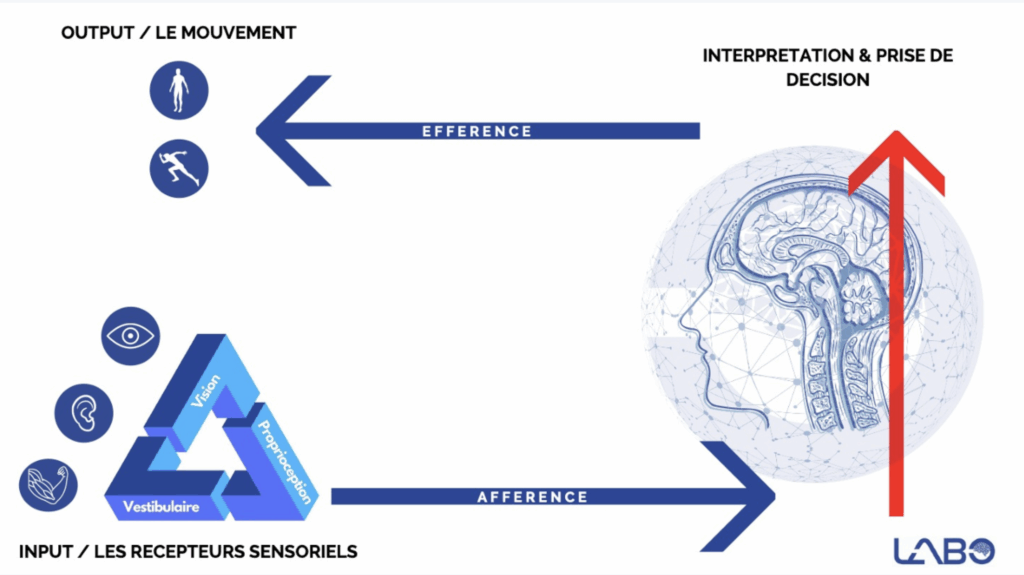
If we specifically examine the last stage of the sensory-motor loop, we realize that movement (the output) consists of two parts: reflex stability and voluntary movement.
To be even more precise, we can break down this output. Indeed, movement (whether athletic, daily, etc.) is divided into three successive stages:
- Proactive reflex stability
- Voluntary movement
- Retrospective reflex stability
Thierry Paillard, a neurophysiologist, mentions in his book “Brain, Posture, and Movement” – book description here, refers to these stages as anticipatory reflex stability, movement, and compensatory reflex stability.
In other words, even before we move, reflex mechanisms come into play to ensure coordinated, fluid, and efficient movement. Then, we can move to perform the chosen movement. But that’s not all, because once we begin to move, an imbalance is created and must be compensated by retrospective or compensatory reflex stability.
This means that the quality of our movement depends on the quality of our reflex stability.

It is interesting to observe these two mechanisms in detail.
On one side, we have two pathways for reflex stabilization for a single pathway of voluntary movement. The reflex stabilization pathways are, by nature, involuntary and governed by the brainstem and cerebellum. While voluntary movement is conscious and depends on the frontal lobe.
These mechanisms highlight the importance of reflex stability in movement. The quality of movement is the result of the quality of reflex stability. Thus, focusing solely on voluntary movement without considering reflex stability is a mistake when genuinely seeking to correct and improve movement.
It is, therefore, crucial to ask the question of the place of training reflex stability in your training plans. Do you give it the appropriate time and role?
After all this theory, let’s return to practice, which interests us the most.
So, concretely, how can we act on reflex stability? To simplify, we just need to focus on the factors that enable this stability.
Let’s take the example of the brainstem. There are many possibilities.
In this article, I will propose three axes of reflection.
In the brainstem, which largely manages anticipatory reflex stabilization, we have:
- Primitive reflexes
- Cranial nerves
- Ascending proprioceptive pathways
This leads us to a significant reflection: primitive reflexes, cranial nerves, and proprioception are interesting tools for acting on reflex stability, provided they are adapted to the individual, AKA individualization!
https://www.instagram.com/reel/C7JSVBQMtVG
https://www.instagram.com/reel/C6lP2woMqzp
https://www.instagram.com/reel/C6Q1jyMN5j
https://www.instagram.com/reel/C6NgBgaNwu9
The Final Word
The choice of exercise stems from a precise assessment aimed at determining the individual's needs. The inherent goal is to calibrate the sensory-motor loop, one of whose objectives is to address the great overlooked aspect of training: reflex stability.
That’s all from me!
Seb
Read next
LabO Notebook
Mastering the Art of Motor Learning: The Revolutionary Approach of the OPTIMAL Theory
Discover how the OPTIMAL theory transforms motor learning by combining intrinsic motivation and attention to boost your sports performance and optimize your movements.
Read the article LabO NotebookNeuro and Stress: A Journey into the Heart of Emotional Responses
Discover how the brain processes stress and regulates our emotions. Dive into essential neural mechanisms, from the reflex to the amygdala, to better understand our reactions to danger.
Read the article LabO NotebookUnderstanding Primitive Reflexes in 5 Minutes
Discover primitive reflexes, these archaic movements that spark debate and curiosity. In under 5 minutes, unveil their functioning and form your own opinion!
Read the articleReady to read the loop before the movement?
The RNP system is meant to be read, targeted and tested from your next assessment. Start with the member space, for free.