The Foot: A Masterpiece of Engineering and a Work of Art
Discover how the foot, a true masterpiece of engineering, plays a key role in sports performance and posture. Learn to harness your ground power!
The RNP training space, free for life
Get access to RNP training, no strings attached.
For over 10 years, I have been a physical trainer, helping athletes across various sports to improve movement and performance. In 100% of cases, working on the foot has been a great idea!
The foot is a magnificent yet very complex structure.
In the field of posturology, the foot plays a much more significant role than just being a link in the postural chain. As both an effector and a sensor, the foot occupies a crucial position, being in direct contact with the ground. This small surface acts as a connection point between our body and the ground, making it an essential player in various areas such as physical training, sports performance, and maintaining postural stability.
A functional foot is therefore of paramount importance, as it directly influences the overall functionality of the body. A foot with dysfunctions can lead to disturbances throughout the entire bodily system, which can be problematic when we focus on movement and physical performance.
Evolution of the Human Foot
“The human foot is a masterpiece of engineering and a work of art” L. Da Vinci

The story of the evolution of the foot is fascinating and can be divided into two parts: phylogenesis, which is the evolution of the species, and ontogenesis, representing the evolution specific to the individual.
On a phylogenetic level, one of the significant milestones that distinguished us from our chimpanzee ancestors was the transition from tree-dwelling to bipedalism, around 6.5 to 5.5 million years ago. The first permanent bipeds were the australopithecines, whose toes had lost their prehensile character. This evolution brought about various modifications and adaptations of the foot as such, and some researchers, like Olivier Donnars, consider this a true biomechanical revolution. It is interesting to note that this evolution of the foot is also linked to the origin of primitive reflexes, including palmar and plantar grasp reflexes.
A remarkable fact highlighted by paleontology is that the evolution of Man did not begin with the head and intelligence, but with the ability to stand upright.
This upright posture was made possible by the evolution of the foot. This means that the evolution towards modern humans, as we know them today, started not with the development of the skull, brain, and supposedly more evolved functions, but with the adaptation of the foot.
This transformation led to biomechanical adaptations at the foot level, as well as at other levels of the body. It was accompanied by pelvic modifications, a decrease in toe mobility, straightening of the knees, an increase in joint movement amplitude, development of the skull, and changes in spinal curvatures to facilitate an upright stance.
Now let's return to the foot itself! The foot has evolved from a role of "grasping" and "climbing" in chimpanzees to gradually becoming a "small walker," a "great walker," and then a "permanent biped" with the australopithecines. Homo habilis marked a stage where the foot became entirely "human," followed by Homo erectus with very specialized hands and feet.
Today, the human foot fulfills three main functions, as defined by E. Legeard:
- Absorb ground reaction force.
- Store elastic energy.
- Transmit muscular force of the impulse to the ground.
It is fascinating to realize that the human foot is the result of a long phylogenetic development! But what is even more remarkable is that the adult human foot is also the result of an ontogenetic learning process. The creation of the plantar arch and the functions of the foot develop during childhood. A flat foot at birth and in early childhood is completely normal! It is through the integration of various primitive reflexes like the plantar reflex and the Babinski reflex, as well as different motor strategies such as crawling and creeping, that the child gradually develops the foot as we know it in adulthood.
This is an extraordinary evolution! Now, let's explore the current characteristics of the human foot in more detail.
Characteristics of the Human Foot
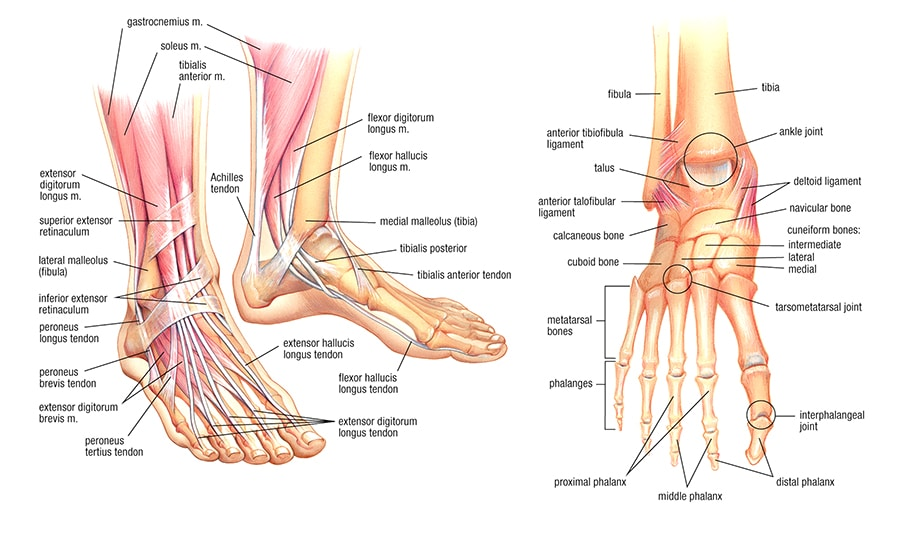
The human foot is a true anatomical and functional feat that distinguishes it from other animal species. To better understand its importance, let's look at some fascinating figures. The human foot consists of:
- 26 bones
- 33 joints
- 20 intrinsic muscles (not counting the extrinsic muscles that are also attached)
- 112 ligaments
- 7,200 nerve endings
It is incredible to note that nearly 25% of the muscles and bones of the body are located below the ankle, while the foot itself represents only 1% of body mass and supports nearly 99% of body weight. This distribution highlights the critical importance of the foot in postural stability and locomotion.
If we correlate all this data with somatosensory/proprioceptive information as discussed in the course scheduled for Tuesday, February 20 (free registration: Registration link), the foot is a true sensory highway that feeds the brain. It feeds the sensory-motor loop to create an output, posture. More specifically, this information comes from:
- At the level of muscle spindle fibers
- From Golgi tendon organs
- From Ruffini receptors
- From Pacini receptors
According to the associated structures.
Clarification regarding muscle spindle fibers (MSF).
The response of muscle spindles to stretching is not linear. Their gain is 10 times greater for stretches of about one-tenth of a millimeter than for stretches of about a millimeter (Matthews and Stein, 1969). This fundamental physiological data is commonly used in humans in experiments involving muscle vibrations (Roll, 1981, Roll and Vedel, 1982).
In other words, MSF do not provide the same information depending on the degree of stretch. Their response is 10 times greater for small deformations (on the order of one-tenth of a millimeter) than for larger deformations (on the order of a millimeter).
To illustrate this idea, one might say that we will get much more sensory responses with a needle than with a pebble. This is an image to emphasize that small deformations are detected much more sensitively than large deformations. It is therefore crucial to pay particular attention to what we put under our feet, whether in terms of insoles or shoes. These choices can significantly influence our perception of the ground and our postural stability. This is also the subject of another article written by Adrien on the topic: Link.
Roles & Functions
The foot is a complex structure, which could be described as a mosaic, polyarticular, and compliant, according to Cornu in 2000. In simpler terms, the human foot is the result of its evolution and fulfills functions that are unique to humans: bipedal locomotion, as well as support and postural stability by bearing the entire weight of the body.
It forms with the eye what is called the visio-pedal axis, making it the primary or secondary major sensor of posture and postural stability for movement.
“What matters in a vase is the empty space in the middle” Sartre. For the foot, it is somewhat the same. The hollow of the plantar arch, let’s remember, is a developmental acquisition both phylogenetic and ontogenetic, and it is this hollow that allows humans to express their unique abilities. It can be compared to a natural spring that serves three main functions, as defined by E. Legeard:
- Absorb the ground reaction force, which means damping;
- Store elastic energy;
- Transmit the muscular force of the impulse to the ground, thus allowing propulsion.
All these functions are essential for maintaining postural stability, facilitating bipedal walking, and performing other movements such as running, jumping, and many more.
The foot also presents particular interest, as it represents the terminal suspension point of the inverted pendulum, a concept developed by B. Bricot. It balances on a harmonious support triangle formed by the two feet, and this greatly contributes to our overall balance and our ability to maintain movement.
Final Thoughts
Before arriving at situations that we can implement in training, it is important to remember that the foot, with its many muscles and three arches (transverse, external longitudinal, and internal), is often overlooked in physical preparation and sports coaching, when it should occupy a central role in training programs. Now you understand why! The foot is the result of millions of years of evolution, long before the evolution of human intelligence. A reality to ponder!
P.S.: Although important, the foot is just one component of a much larger equation: the human body
That's all from me!
Seb
Some Training Situations
https://www.instagram.com/reel/C11vakGsNpC
https://www.instagram.com/reel/CzJKzp-Onv2
https://www.instagram.com/reel/C3Vf9sStMjC
https://www.instagram.com/reel/C2xGb2GtXyZ
Read next
LabO Notebook
Mastering the Art of Motor Learning: The Revolutionary Approach of the OPTIMAL Theory
Discover how the OPTIMAL theory transforms motor learning by combining intrinsic motivation and attention to boost your sports performance and optimize your movements.
Read the article LabO NotebookNeuro and Stress: A Journey into the Heart of Emotional Responses
Discover how the brain processes stress and regulates our emotions. Dive into essential neural mechanisms, from the reflex to the amygdala, to better understand our reactions to danger.
Read the article LabO NotebookUnderstanding Primitive Reflexes in 5 Minutes
Discover primitive reflexes, these archaic movements that spark debate and curiosity. In under 5 minutes, unveil their functioning and form your own opinion!
Read the articleReady to read the loop before the movement?
The RNP system is meant to be read, targeted and tested from your next assessment. Start with the member space, for free.