The 4 Skills Every Athlete Should Master to Move Well
To perform at their best, every athlete must master four key skills. Discover how Neuro-Postural Reprogramming can revolutionize your movements and training!
The RNP training space, free for life
Get access to RNP training, no strings attached.
As a physical trainer, I have over 10 years of experience coaching athletes, and nearly as many years using the principles of Neuro-Postural Reprogramming in assessment and training to enhance movement. (I want to assure you, over the past decade, my training system has evolved significantly and no longer resembles its early days. What you discover today is the result of my practical reflections and research conducted throughout these ten years!)
Over the years, I have found that despite the increasingly complex and precise approach we can develop, there are four fundamental skills/competencies that every athlete, and indeed every individual, should master.
Before explaining these four skills in detail, let's revisit the basics of Neuro-Postural Reprogramming. These foundations are essential for understanding how these skills interact to improve movement as a whole.
To understand the fundamentals of movement, it is crucial to look at how the nervous system operates. Indeed, our ability to move is orchestrated by our brain, which sends directives to our muscles on how to move. This underscores the importance of the brain in the movement process, a fact often underestimated.
As professionals dedicated to the study of movement, it becomes paramount to closely examine the mechanisms of how the brain functions.
To deepen our understanding of these processes, we explore the perception-action loop, also known as the sensorimotor loop. This key concept allows us to break down and analyze more finely how the brain interacts with the rest of the body to produce movement.
The Sensorimotor Loop: How to Move!

This sensorimotor loop consists of 4 stages, where sensory input fuels the motor response; where sensory information enables movement:
- The gathering of sensory information through various receptors, such as the vestibular system, proprioception (skin, muscles, tendons, etc.), the visual, olfactory, gustatory, and auditory systems, grouped under the terms proprioception, exteroception, and interoception.
- The processing of this information by the central nervous system.
- The decision-making for an effective and efficient voluntary movement.
- The execution of the voluntary motor command to perform the movement.
This may seem complex, but in practice, it boils down to:
- My eyes see my coffee cup (my nose smells it;))
- The brain processes this visual information to assess the distance and exact location of the cup.
- The brain decides on the precise movement to make to grasp the cup.
- Activation of the necessary muscles to take the coffee cup.
The takeaway is that the quality of movement (step 4) depends on the quality of the preceding steps.
Now that we share a common understanding, let’s discuss the four essential skills every athlete should master. These skills are the result of extrapolating sensory inputs into motor qualities, highlighting the importance of perception in developing physical fitness:
- Seeing well
- Balancing well
- Moving well
- Integrating well
Seeing Well
Seeing well pertains to the sensory input related to vision. To generate movement that is both effective and efficient, good vision is essential. This encompasses all visual abilities, including some of the more well-known ones like peripheral vision, the ability to grasp visual information, convergence, as well as other oculomotor skills.
I remember monitoring a professional football player who had a significantly narrower visual field on one side compared to the other. What complicated his situation was that he played as a defensive midfielder. With a reduced visual field on one side, it’s understandable that he tended to lose the ball more frequently when an opponent approached from that side and also tended to position himself consistently on the same side.
https://www.instagram.com/reel/C2pQlwfs9mX
Balancing Well
Balancing well refers to the sensory input from the inner ear; or the vestibular system. Our inner ear – and all its receptors – enables our body to balance, represent itself in space, and keep our eyes steady while the head or body is in motion. Imagine for a moment a basketball player who loses sight of the ball every time he is in motion. It quickly becomes complicated for him to perform. Yet, this is what happens – on a smaller scale – for all individuals with a poorly calibrated vestibular system.
*Balance is closely related to the sensory input coming from the inner ear, also known as the vestibular system. The inner ear, with its many receptors, plays a crucial role in allowing our body to maintain balance, locate itself in space, and keep the eyes stable while the head or body moves.
Imagine, for example, a basketball player who would lose sight of the ball every time he moves: his performance would be greatly affected. It’s a similar situation, albeit less extreme, for individuals whose vestibular system is poorly calibrated.
https://www.instagram.com/reel/C2P943SsSma
Moving Well
The category most frequently trained in the world of training concerns, in part, somesthesia, meaning proprioceptive and tactile perception. Rather than detailing all the receptors, let’s focus on the concept of ‘mapping’, or the ability to represent the body in space. Let’s take the example of a person who is not very athletic. Indeed, Neuro-Postural Reprogramming (NPR) is not exclusively reserved for enhancing high-level performance but also aims to adjust for anyone wishing to move without tension, constraint, or compensation.
Imagine a person with inadequate perception and insufficient stimulation of the somatosensory receptors around the back. Considering various receptors, such as those in the muscles, joints, and ligaments, a lack of proprioceptive information in this area can make every movement of the back potentially risky, thus increasing the risk of tension or pain. This situation highlights the importance of proper proprioceptive calibration for safe and effective mobility.
https://www.instagram.com/reel/C2xGb2GtXyZ
The Unifying Element: Integrating Well
The three mentioned skills are crucial for an athlete looking to maintain optimal health, as they contribute to the precise calibration of the sensorimotor loop.
Referring back to the initial concept of the sensorimotor loop (reference to the first part of this article), inadequate sensory information can lead to an incorrect reaction or movement: ineffective, compensatory, adaptive, and potentially risky for the organism.
The ability to see well, balance well, and move well constitutes the essential motor foundations for a calibrated and healthy nervous system.
However, it is important not to neglect the fourth skill, which also plays a vital role in optimizing performance and overall health for an athlete.
Integrating Well
It would be possible to dedicate an entire article solely to this skill. However, we will try to remain as concrete as possible. Integrating well also means having the ability to integrate the three previously mentioned skills: seeing well, balancing well, moving well. This integration is often overlooked in the training world.
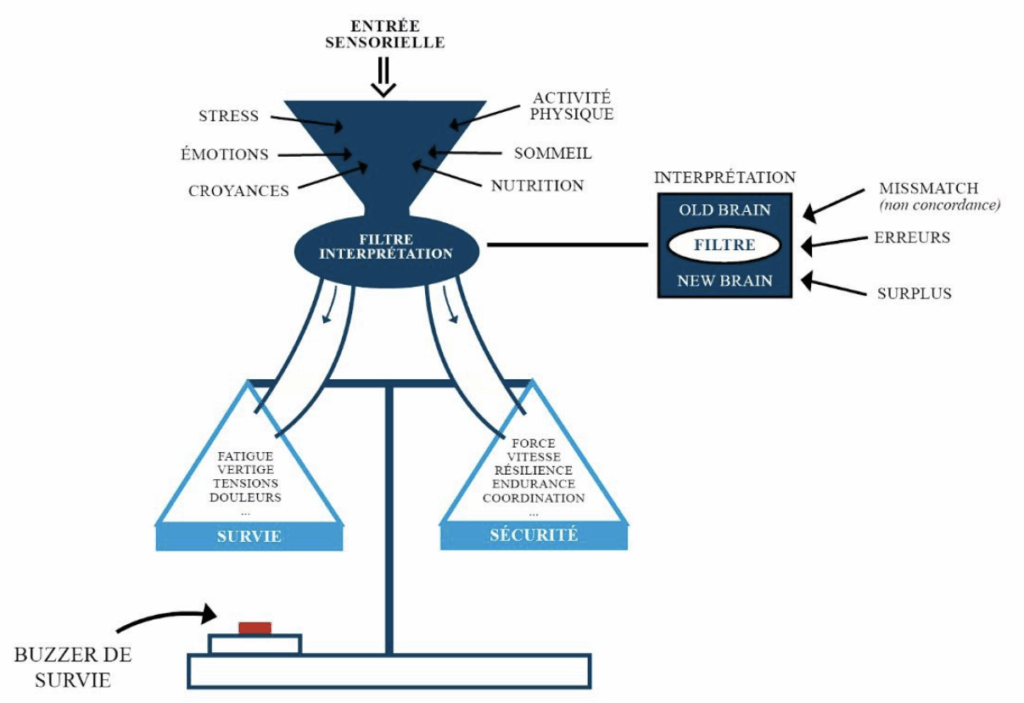
Imagine a proprioceptive system (moving well) developed to its maximum, offering a high level of representation, capable of moving all parts of the body precisely and rhythmically (which is already remarkable in itself), but paired with a vestibular system (balancing well) that is at its lowest, constantly losing balance… It is evident that this will lead to compensations or “energy leaks,” which we call “sensory non-concordance.” (This will be developed in a future article).
One of the most well-known sensory non-concordances? Motion sickness. Have you ever been on a train and felt the movement of another train nearby, giving you the impression that you are moving while you are stationary? That’s the idea. One form of motion sickness stems from this discordance between the visual system and the vestibular system.
The Final Word
The goal through Neuro-Postural Reprogramming is to precisely calibrate all the different sensory receptors, individually and then integrate them together in movement. This is how we achieve optimal movement.
Our ultimate goal: to calibrate the sensorimotor loop for optimal movement. We use sensory inputs to access the nervous system, and thus the overall movement.
If you wish to delve deeper into these concepts, I offer a 30-minute training session that includes several exercises to test with your clients: Free 30-minute training.
That’s all from me!
Seb
Read next
LabO Notebook
Mastering the Art of Motor Learning: The Revolutionary Approach of the OPTIMAL Theory
Discover how the OPTIMAL theory transforms motor learning by combining intrinsic motivation and attention to boost your sports performance and optimize your movements.
Read the article LabO NotebookNeuro and Stress: A Journey into the Heart of Emotional Responses
Discover how the brain processes stress and regulates our emotions. Dive into essential neural mechanisms, from the reflex to the amygdala, to better understand our reactions to danger.
Read the article LabO NotebookUnderstanding Primitive Reflexes in 5 Minutes
Discover primitive reflexes, these archaic movements that spark debate and curiosity. In under 5 minutes, unveil their functioning and form your own opinion!
Read the articleReady to read the loop before the movement?
The RNP system is meant to be read, targeted and tested from your next assessment. Start with the member space, for free.