Looking Far to Ride Fast
Improve your mountain biking skills by learning to look ahead to anticipate obstacles and paths. Discover practical techniques to optimize your speed!
The RNP training space, free for life
Get access to RNP training, no strings attached.
How to Successfully Look Far?
Riding Technique
Everyone who has trained in mountain biking, regardless of the discipline, has certainly heard this phrase...
"Look up, you can't see the obstacles".
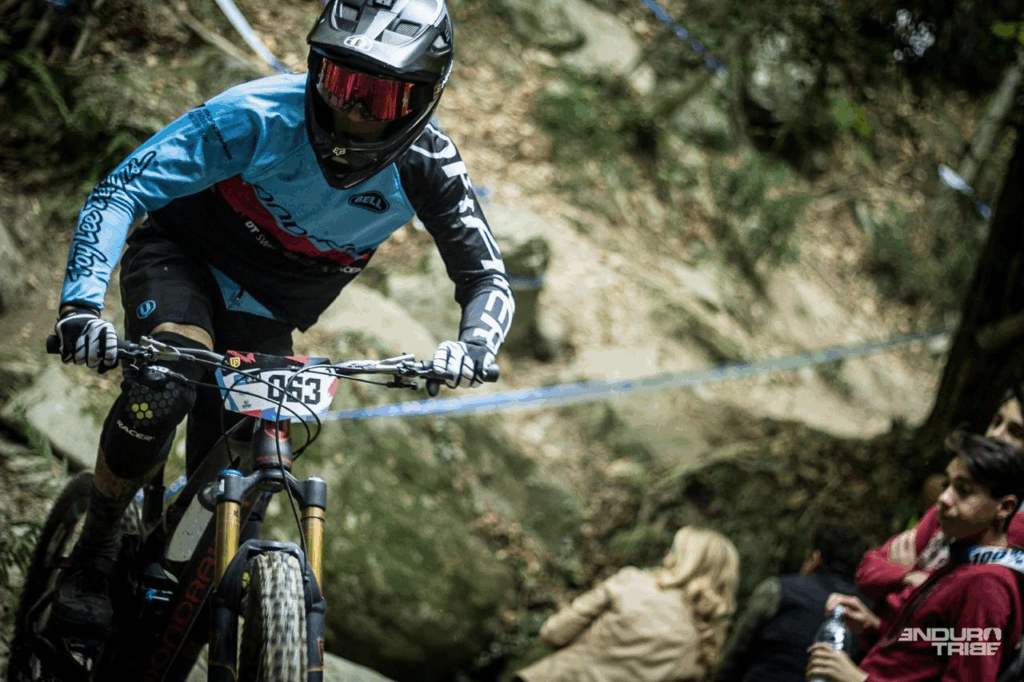
Looking far ahead has many advantages; it allows you to anticipate your paths, obstacles, etc. to ride faster.
But why is it so difficult to look far ahead? Coaches have looked into this issue and have come up with many ideas to create suitable exercises. Many riders recall spending long hours trying to spot ribbons at the exits of each turn.
Can we find other ways to improve our vision?
The Visual SystemAlmost 90% of the information from our environment goes through our visual system. Composed of two globes, each eye sends an image to the brain. The brain then overlaps them and creates a single clear image.
Binocular vision allows for a 3D image and distance assessment. Successfully looking in the right direction depends on the coordination of the six ocular muscles that articulate the eyeballs.
Eye movements allow you to shift your gaze. This involves perfect coordination between the two eyes.
The organization of the combined vertical and horizontal movements of the eyes is complex. When both eyeballs converge on the same target, the image is sharp and it is easy to place your gaze where you want.
Even in daily life, this can be a real handicap! A misaligned eye sensor can cause postural imbalances, neck pain, migraines, etc. Riding your bike will therefore become a challenging task. It will require a lot of attention and energy. Therefore, improving ocular convergence should be a priority by working on the ocular muscles.
Successfully interpreting what you see The image is reflected on the retina, which consists of cones for central vision and rods for peripheral vision.
Cones distinguish colors and details but only perform well in high light conditions. Peripheral vision is equally important. Rods are better at detecting movement; they are also responsible for night vision, shapes, and changes in light.
Peripheral vision is not as effective as central vision for capturing details, BUT it is better for seeing movements. Peripheral vision is crucial for moving around easily. Therefore, you need to work on your ocular muscles and peripheral vision simply, either during specific sessions or in your warm-up routine, for example.
"Athletes can be more effective using their peripheral vision with practice. Having excellent peripheral vision can open up huge possibilities." G.Hayes
By Gaël Faury Physical Trainer – Neuro-Cognitive Development
INSTAGRAM: SET-UP PERFORMANCE
Read next
LabO Notebook
Mastering the Art of Motor Learning: The Revolutionary Approach of the OPTIMAL Theory
Discover how the OPTIMAL theory transforms motor learning by combining intrinsic motivation and attention to boost your sports performance and optimize your movements.
Read the article LabO NotebookNeuro and Stress: A Journey into the Heart of Emotional Responses
Discover how the brain processes stress and regulates our emotions. Dive into essential neural mechanisms, from the reflex to the amygdala, to better understand our reactions to danger.
Read the article LabO NotebookUnderstanding Primitive Reflexes in 5 Minutes
Discover primitive reflexes, these archaic movements that spark debate and curiosity. In under 5 minutes, unveil their functioning and form your own opinion!
Read the articleReady to read the loop before the movement?
The RNP system is meant to be read, targeted and tested from your next assessment. Start with the member space, for free.