How to Revolutionize Your Riding with Core Training?
Revolutionize your riding with core training! Discover insights from Emmanuel Legeard on an innovative approach to core training beyond traditional abs.
The RNP training space, free for life
Get access to RNP training, no strings attached.
Core training… planking… Where to start?
The concept of planking has been originally and critically redefined by Olympic coach Emmanuel Legeard, an expert in strength disciplines.
“For the past ten years, it has been fashionable to center training around an approximate concept of planking inspired by American fitness. How to convey that planking is not achieved through sets of crunches, but by learning to engage in the right order the "speeds" of the descending motor pathways. These motor pathways activate neurological patterns that are somewhat nested within each other like Russian dolls. As long as we ignore this functioning, it is impossible to exploit it skillfully. From this perspective, the return of weightlifting as a mass phenomenon is beneficial because it leads to considering the body as a finalized whole, contrary to the idea that the body is merely the sum of its visible parts.”
According to him, the simplistic and static notion of planking that is currently in vogue must be deeply revised to once again fulfill its useful function: to allow
“the exploitation of synergies following physiological strategies, in other words, to provide impulses in the right direction, recruit the right muscles in the right order…”
Planking
“...not through sets of crunches, but by learning to engage in the right order the "speeds" of the descending motor pathways...” E.LEGEARD

The CORE, or "core", is generally about working the abdominal-lumbar belt, the "trunk", and the "deep muscles", which are exercised to create stability, the foundation of athletic movement.
The approach aims to be functional.
This "traditional" planking aims to work different muscle chains simultaneously.
But is this method the most effective?
Can we achieve better benefits?
Traditional planking relies on "conscious" effort, whereas during riding phases we need unconscious recruitment. Neurologically, we have little conscious access to the musculature surrounding our spine. Most of the control is reflexively commanded.
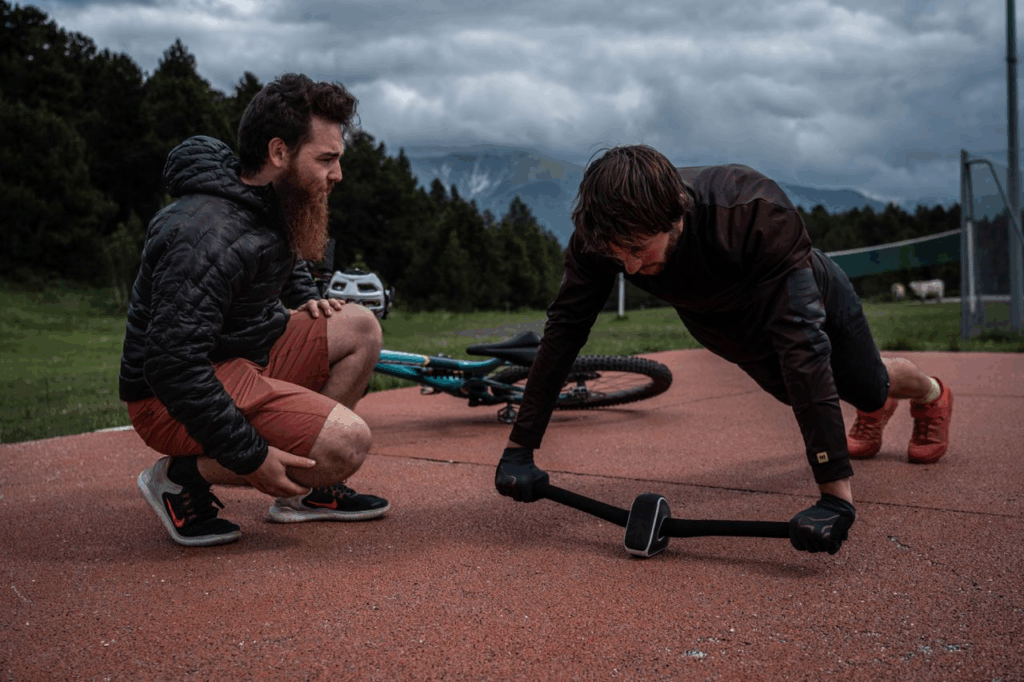
Core training... not so Core after all...
When we overly direct our consciousness towards areas that should be controlled reflexively, it becomes costly in energy, which can lead to difficulties in adapting to other stress factors or unpredictable disturbances.
Can we improve riding by analytically activating our "core" muscles as we do with "traditional" planking?
In a recent study, researchers found no link between these types of exercises and any influence on deeper core or stabilizing muscles. The activation patterns of the trunk muscles change depending on the movement.
“More than 70% of our sensory input is provided by our visual system...”
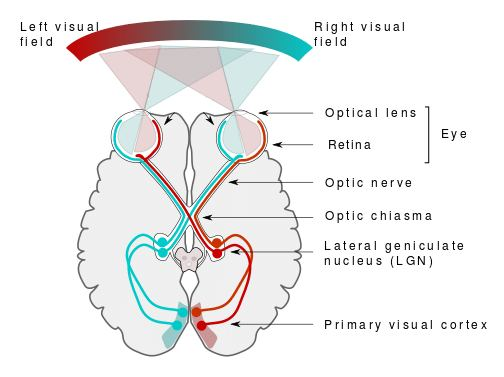
How? Planking at the Service of Riding
The goal is to be faster on the bike. So, how can we advance riding technique through PLANKING?
A technical gesture is the learning of a movement correctly coordinated between the environment and the athlete to accomplish a task. More than 70% of our motor learning is ensured by our visual system. Our visual system initiates our movement intention. By acting on the right levers, we will make stability, force transfer, and especially reflex functions, more efficient.
This will naturally improve cycling performance.
By applying the principles of PLANKING following a neurological approach, as redefined by E.LEGEARD, we can provide the rider with the keys to access a significant improvement in their technical learning, movements, physical potential, and ultimately, their riding.
PLANKING thus finds its place at the center of physical preparation for riders aiming to improve performance or prevent injuries. It is also a great way to introduce physical preparation to younger individuals in a playful manner, without resorting to boring elbow planks or wall sits...
“A technical gesture is a movement correctly coordinated between the environment and the athlete to accomplish a task.”
By Gaël Faury Physical Trainer – Neuro-Cognitive Development
INSTAGRAM: SET-UP PERFORMANCE
Download our E-Book for more field tests for free
Read next
LabO Notebook
Mastering the Art of Motor Learning: The Revolutionary Approach of the OPTIMAL Theory
Discover how the OPTIMAL theory transforms motor learning by combining intrinsic motivation and attention to boost your sports performance and optimize your movements.
Read the article LabO NotebookNeuro and Stress: A Journey into the Heart of Emotional Responses
Discover how the brain processes stress and regulates our emotions. Dive into essential neural mechanisms, from the reflex to the amygdala, to better understand our reactions to danger.
Read the article LabO NotebookUnderstanding Primitive Reflexes in 5 Minutes
Discover primitive reflexes, these archaic movements that spark debate and curiosity. In under 5 minutes, unveil their functioning and form your own opinion!
Read the articleReady to read the loop before the movement?
The RNP system is meant to be read, targeted and tested from your next assessment. Start with the member space, for free.